Many people have daily, weekly, monthly, and sometimes even life-long goals. The purpose of a goal is having a target you can firmly set your sights on and aiming to achieve that said target. I've already written a post about why goals are important to have in your life so I won't go into that in this article.
If you are wanting to know why it is important to have a goal in your life, you can view that here: 'Why you Need a Goal'.
Sometimes finding the motivation to get yourself to actually commit to your goal can be tricky and so that is why a lot of people use motivational tricks to help them.
One of these motivational tricks you can use is the '1 Minute a day goal'. It may sound too good to be true, 1 minute a day!, and I can complete my goals?, well, let me explain first.
When we have a goal (or goals) we will need to dedicate some of our time in trying to achieve it otherwise we will never succeed in its completion. The time we dedicate in trying to finish a goal can be done once a day, once a week, or whenever we decide, etc. However, making sure that we do take time out of our day to pursue these goals can be hard and motivation is a real key to this. If we lack motivation then we aren't as likely to do something and so our self discipline needs to be at a higher level in order to make ourselves carry out this time. However, many of us aren't strict with ourselves and don't incorporate enough self-discipline to make sure we carry this out.
Something like 30 minutes everyday can help make tremendous progress towards your goal and will often help see you succeed (dependent upon your time-scale and the scale of the task), yet some people don't have enough time in the day for 30 minutes of 'goal achieving time'. So this is where the '1 minute a day goal' comes into the picture. This goal is for those of you who don't have much time at all but yet still want to pursue your goal.
When we think of a minute, it's really no time at all - 60 seconds and it's over. The aim of this is for you to dedicate 1 minute of your time every day to pursuing your goal. 1 Minute - that's all. A minute isn't going to have an impact on your day and is very easy to motivate yourself to do...but that's the point. Because you will find it very easy to do something for only a minute, often you can easily overrun the original 60 seconds. That 1 minute then becomes 5 minutes, and that 5 minutes then becomes 10.
Conclusion
This motivational techniques is all about getting you to commit to your goal a minute a day. The daily target is this short because it has the intention for you to overrun and spend longer.
Realistically doing only a minute a day isn't really going to help you with your goal nearly as much as 30 minutes or an hour is, and so I wouldn't recommend it for medium-sized to larger-sized goals. But for those smaller goals and who don't have much time on their hands, this could be what you are looking for.
Tampilkan postingan dengan label Motivation. Tampilkan semua postingan
Tampilkan postingan dengan label Motivation. Tampilkan semua postingan
Kamis, 13 Juni 2013

Senin, 25 Maret 2013
Don't Give Up
Is there something that you would really like to be good at or succeed in? I'm sure there is when you think about it? Maybe you've always wanted to play a musical instrument, or maybe a renowned artist, or are you wanting to become an author? We all have aspirations of what we would like to do or be good at, however, there always seems to be something that holds us back...ourselves.
It can be very easy to say that you want to be an astronaut or want to become an artist, but like all things, you will need to put in the work and effort. Don't give up! It can be all to easy to stop when the going gets tough but remember without hard work how are you supposed to improve? It's like someone who goes to the gym and works-out. If that person doesn't put in the effort to making sure his/her muscles are working hard then there isn't going to be much improvement.
Hard work can be tiring but is something that produces results when you keep it up, and that's what you need to keep in mind - to keep going and pushing yourself forward to your goal, your ambition!
Other people can also play a big part too. If you get people around you who are encouraging you then this will help your morale and aid you in driving onwards. On the reverse if you get people telling you that you are wasting your time and that you are never going to get anywhere with it, this can have a discouraging affect. Interestingly though when people are discouraging to you, this can also act as motivation to assist you, by wanting to prove your critics wrong and showing them that you can succeed.
If you do find it tough and the road arduous then there will be no doubt that you will feel like quitting along the way, maybe only the once or maybe several times. When I was learning to play the piano there were many occasion that I wanted to give up but am glad now that I didn't, because now It's something that i couldn't imagine not being in my life - it's definitely a hobby that I'm grateful to have.
A thing that I do when working hard at something that has helped keep me going in many a situation is to think of who else I know is doing what I am doing. That person/or people then become my rival(s) in my head and aid in persisting with what I am doing. For example: I have recently started going to the gym, coming up to two months now, and I know a few other people who also go. I can tell you that it is hard work and sometimes I really don't feel like going, but thanks to thinking about the people I know going to the gym and working out, it unleashes my competitive side and drives me to work-out so that I can better them. I do this for a lot of things and it's something that helps me to carry on.
In conclusion, yes if you are wanting to improve at something or be good a something or get the job of your dreams etc, you are going to have to apply yourself and work hard, just remember: don't give up.
If you do find it hard with motivation then a trick that might interest you is this: Don't Break the Chain.
Kamis, 26 April 2012
How to Find Inspiration
Inspiration! When we have it, we feel on top of the world. So much can be done through inspiration and has served many individuals well over the course or history.
Somehow it can just appear out of no-where and hit us straight on, helping us to further ourselves along the road.
Yet, as quickly as inspiration can come, it can vanish just as quickly. It's a horrible feeling, wanting to do something, but yet at the same time not really wanting to because of the fact that your uninspired, and so your drive has left you.
So is there a way we can get inspiration back into our lives?, not only obtain it, but hang on to it?
Well, I think that the answer is yes, and although the first reaction may be 'great', it isn't always successful and isn't always that easy to gain.
So here's a few tips that will hopefully allow you to get some inspiration, if none of these work, then maybe you need to come at it from a different angle, or maybe you're pursuing the wrong thing?
1. Friends or groups
A great way to find inspiration is by being around other individuals who also share your passion. It can be friends, or it can be a group that meet up just for this, whichever one you opt for, you are bound to find some level of inspiration.
Wanting to share your experiences and knowledge with others is common, and so being around like-minded people will help to develop your love for what your doing, but also encourage you to continue with it, and maybe bring out a bit of competitiveness. (Competitiveness is also good for inspiration as it drives you forward).
2. Historical Examples
Another great way to find inspiration is by searching back through history (recent and not so recent), finding out about individuals who were in a similar situation to yours.
You can see how they dealt with their situation, how they made correct or incorrect choices, and their end results.
3. Success stories
You could really sort of include this in point#2, but yet not really.
Looking at other people's success stories, ones relating to what you're doing, can really aid in inspiring you to continue. This can be especially true when they've come from where you are (situation-wise not location-wise), or even from a worse-off place than you.
See how they did it, look into what inspired them, and try to follow some of their examples.
4. Forums
Similar to point#1, except this won't be with human contact, yet you'll still be able to get other peoples ideas and suggestions.
There are millions of people who use forums, and there are millions of forums catering to different topics.
Find a forum that you would like to get involved in, sign up, then get stuck in. You could maybe use the 'don't break the chain' motivational technique to make sure you stick at it.
After a while of forum posting, you will start to be recognised and others will start to respect what you have to say more.
5. Magazines, books, blogs.
A good magazine, book, or blog, will be filled with ideas, stories, and other things to help you crack on with what you want to achieve.
Often magazines will let you send in letters and will feature the best ones. You are able to read others to see how they're getting on, and also send in some letters of your own. If you're lucky enough to get a letter featured, this will surely give you some more incentive to be spurred on.
Many blogs will also allow you to participate, normally through commenting. You can read other peoples views and feedback on what you've just read.
With so many blogs out there, I'm sure there will be one for you.
I can think of many times I've lost inspiration for this blog, but reading other blogs out there and relating to some of the bloggers personal situations has helped me somehow continue, and find my 'mojo' as it were.
6. Quotes
As simple as it sounds, quotes can really help you to continue what you're doing. Find some quotes you're fond of and stick them where you know you're going to see them, post-its are good for this.
Quotes to do with motivation are good, and if you're interested, here's a post I wrote a while ago: 50 Motivational Quotes.
7. Go for a walk
Often just allowing yourself to go for a walk alone in a peaceful environment, will allow you to really hear yourself think. I find when walking (or exercising in general), ideas seem to accumulate inside my head. Normally I don't have anything to write them down with, so I have to try and remember them, but its just easier and more convenient to have a pen and pad at hand.
I find one of the best times in the day is early morning. Everything is so still and peaceful it's brilliant. Although a problem with early morning walks I find living in England, are not the warmest, so don't be fooled by the sun.
8. Have a Journal/Notebook
A simple yet effective source of inspiration can be your own ideas and thoughts. Write down these in a plain notepad/journal, and then slowly develop them from there.
I use one for blogging so I can write down future post suggestions and any changes I may want to make to the blog now or in the future. I also keep track of where I am with the blog now, and expand upon previous ideas.
It takes some getting used to, but after a while of using one - you'll see the benefits.
Don't Break the Chain
I find that when I first start something new and exciting, my passion and enthusiasm for it are through the roof.
So for the first few days my excitement and quest to get stuck-in levels, if they could be measured, are on an all new high. After these first initial days have passed though, I find that I start to plateau and then soon become bored.
This is common for many, and is a problem for me personally. I always find that I do this, I find something that I want to do, stick at it for a few days or a week and then never come back to it, or maybe come back to it a year later.
Even long-term commitments I have trouble with (not talking relationship-wise), for example this blog, there have been some weeks when I've spent hours each day on different posts, and then not blog for a week or so.
This is where motivational practices and techniques come in, and there are really a whole host of different ones to choose from. One that I've recently come across and I think is really simple and effective, is called 'Don't Break the Chain'.
It's a productivity/motivational technique publicised by Jerry Seinfield. Seinfield came up with the technique when he was trying to come up with better jokes for his career as a comic. He noted that spending time each day writing a joke was more beneficial than spending hours one day a week writing many jokes.
The key is consistency. 'Consistency breeds momentum' and is a great tactic to implement into your life.
I personally love this motivational gem. Basically what you do is, pick a task or something that you want to start doing. For example: start a blog, start exercising, start learning a musical instrument, start whatever you want, but with the intention of wanting to stick at it.
Next, print out or draw out a calendar year onto one piece of paper. Make sure it's a grid calendar, or even in fact just a grid of 365 squares. Then write at the top of the piece of paper: 'Don't Break the Chain' and your task next to it. Also write down the minimum amount of time you think you can handle to do daily.
So for example, I have one for blogging. I have set myself a goal of spending at minimum half an hour a day writing a blog post, so nothing extra I do with the blog counts, but just specifically for writing posts for you guys and girls to read.
Now I know half an hour a day doesn't sound like a lot, but remember that's a minimum level of time, and I'd much rather spend 30 minutes a day blogging for a week, than spending 3.5 hours one day a week.
Not only am I more alert by doing this, but the overall quality is improved and because it's only half an hour, I feel compelled to run over time (which I know I wouldn't do after 3.5 hours,).
Not only that, but my concentration is in a much healthier state doing these short sessions every day, rather than one long session a week.
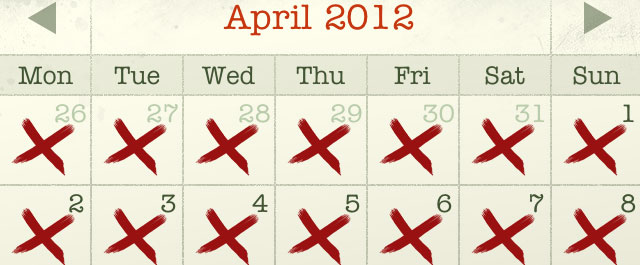
If you achieve your goal, then put a big coloured cross on that day, so you know that you accomplished what you've set out to do. After a few days of doing this you'll notice a chain of crosses start to build up, and like a snowball, it will build up and up, helping you to cement this practice into your life.
Since starting this, I've already noticed a difference in my personal productivity.
Another thing you'll notice is that as you're chain builds up, you'll desire to keep it going without breaking will remain strong. I'm not saying that there won't be days when you really don't care, but stick at it and you won't regret it.
If you do happen to miss a day, don't stress, just get right back to it the next day. I should point out however, that once you miss a day, it can easily cause you to miss another day, then another and so on. So just be persistent.
I don't claim ownership or credit for the picture present, all credit is reserved for the original owner. No copyright intended and I am in no way profiting from the images present. If you have an issue with the picture that is present, then please contact me.
Sabtu, 17 Desember 2011
How to Enforce a New Habit
Choosing and enforcing new habits can be really easy and really hard at the same time. Easy in the choosing of the new habit, hard in the enforcing of it.
Here is a list of simple tricks and tips you can use to make your new habits stick.
1. Do it Daily
When enforcing a new habit, doing it daily is a great way of making it stick. It's also one of the easier ways to help new habits stick, rather than doing it only two or three days a week and forgetting about it.
2. Consistency
It's no good trying to change an old or existing habit or form a new one if you're not going to be consistent in your tackling of it.
Scholars, athletes, musicians and the like, have all had to be consistent in their fields to find success. It really goes along with point number 1, that being a way in which you can remain consistent.
3. Select a period of time
When deciding what new habit you're going to enforce in your life, also decide how long you're going to practice it for (daily). For example ten days, twenty days, thirty days etc.
For a new habit to stick, normally I would give a guideline of about a month or so, of course this is only a guideline.
If you manage to enforce a new habit in less than a month - great, if it takes longer than a month - don't worry.
Although if it's a habit that you need to change ASAP, then of course the sooner the better.
4. Use a Calender
Calenders are a great way of reminding yourself to do something, but not only that you can keep track of how you're doing.
I recommend a grid calender, and plotting out each of your days. Then as you do this new habit each day, you can cross them off to let you know how you're doing.
5. Reminders
If you don't fancy using a calender or would prefer to use another method as-well as or instead of, then placing reminders is the way for you.
Write out a handful of reminders and allocate them to places you know you'll notice them, e.g: on your computer, on your bedroom door, on your car steering wheel, on your shoes, etc.
Wherever you choose to place them, as long as you know you'll notice them then you can have no fear in forgetting about your new conquest. Just don't forget to put out the reminders, maybe you should make yourself some reminders to remind you to lay out some reminders. :)
6. Know why you're doing it
Knowing the benefits of you're new habits will be brilliant for motivating yourself to keep it up. For example I'm trying to become more flexible to try and prevent joint and muscle problems when I'm older. I also have quite a weak back with being quite tall, so I thought why not?
Jumat, 21 Oktober 2011
50 Motivational Quotes
Everybody loves a good quote. Something you may like refer back to in certain circumstances. I've put together a list of motivational quotes that you may like to use.
1. If you do not hope, you will not find what is beyond your hopes.
2. We are all inventors, each sailing out on a voyage of discovery, guided each by a private chart, of which there is no duplicate. The world is all gates, all opportunities.
3. Seek the lofty by reading, hearing and seeing great work at some moment every day.
4. Without inspiration the best powers of the mind remain dormant. There is a fuel in us which needs to be ignited with sparks.
5. We are what we repeatedly do. Excellence, therefore, is not an act but a habit.
6. God is like the sun, which, as we journey toward him, casts the shadow of our burden behind us.
7. Work spares us from three evils: boredom, vice, and need.
8. You cannot plough a field by turning it over in your mind.
9. Do not wait to strike till the iron is hot; but make it hot by striking.
10. Nothing will ever be attempted if all possible objections must first be overcome.
11. Believe with all of your heart that you will do what you were made to do.
12. Knowing is not enough; we must apply.Willing is not enough; we must do.
13. Constant dripping hollows out a stone.
14. Nothing contributes so much to tranquillize the mind as a steady purpose-- a point on which the soul may fix its intellectual eye.
15. There is a difference between must and want.
16. If you wish to find,you must search.Rarely does a good idea interrupt you.
17. Without a sense of urgency,desire loses its value.
18. A creative man is motivated by the desire to achieve, not by the desire to beat others.
19. Act as if what you do makes a difference. It does.
20. Always desire to learn something useful.
21. Always do your best. What you plant now, you will harvest later.
22. Dear children, let us not love with words or tongue but with actions and in truth.
23. Above all, love each other deeply, because love covers over a multitude of sins.
24. Seek the LORD and His strength; seek His face continually.
25. Be gentle to all and stern with yourself.
26. Be miserable. Or motivate yourself. Whatever has to be done, it's always your choice.
27. Determine never to be idle. No person will have occasion to complain of the want of time who never loses any. It is wonderful how much may be done if we are always doing.
28. Do you want to know who you are? Don't ask. Act! Action will define who you are.
29. Love does not delight in evil but rejoices with the truth.
30. I don't believe you have to be better than everybody else. I believe you have to be better than you ever thought you could be.
32. In motivating people, you've got to engage their minds and their hearts. I motivate people, I hope, by example - and perhaps by excitement.
33. Be not deceived: evil communications corrupt good manners.
34. It's always too early to quit.
35. Dear friends, since God so loved us, we also ought to love one another.
36. Know or listen to those who know.
37. If anyone says, "I love God," yet hates his brother, he is a liar. For anyone who does not love his brother, whom he has seen, cannot love God, whom he has not seen.
38. Leap, and the net will appear.
39. Learn from the past, set vivid, detailed goals for the future, and live in the only moment of time over which you have any control: now.
40. Prove all things; hold fast that which is good. Abstain from all appearance of evil.
41. No matter how many goals you have achieved, you must set your sights on a higher one.
42. One way to keep momentum going is to have constantly greater goals.
43. Make sure that nobody pays back wrong for wrong, but always try to be kind to each other and to everyone else.
44. Small deeds done are better than great deeds planned.
45. The wise does at once what the fool does at last.
46. Jesus said, It is more blessed to give than to receive.
47. What you do today can improve all your tomorrows.
48. Let justice roll on like a river, righteousness like a never-failing stream!
49. When you reach the end of your rope, tie a knot in it and hang on.
Jumat, 14 Oktober 2011
8 Advantages you gain from Playing an Instrument
Music can stir up a strong emotion in anyone. Whether it's sad, happy, exuberant, reminiscing, forceful - music has an effect on all of us.
You'll find when you listen to music, there will be things you like and things you don't like, this is your unique taste and is individual to you.
Learning to play an instrument can help you express music that you really love and is very rewarding. Not only will you enjoy it (if you stick at it and it's the right instrument for you), but others will enjoy to listen to you.
To most people who play instruments, they would say it's one of their favourite hobbies which they apply themselves to.
I count myself lucky to have been given the opportunity to play an instrument (piano) and have lessons, but unfortunately for many, this is not the case.
Instruments are expensive and lessons are too (depending who you're with).
That's not to say you have to have lessons to learn an instrument, now with all the resources people have - learning by yourself is easier than it ever has been.
There are many benefits to playing a musical instrument that I never realised and many people don't know about them either.
These only really are true if you play an instrument on a regular basis, otherwise you can't benefit fully from this skill.
These only really are true if you play an instrument on a regular basis, otherwise you can't benefit fully from this skill.
1. Develops intelligence
Not only is music nice to listen to and to play, but some studies have shown that learning an instrument develops intelligence, promoting brain activity and an increase in IQ.
This is because of your brain having to process and concentrate on many different things at once.
For example: emotion and feeling, pressure of played notes, loudness and softness, the changing rhythm, articulation, movements of hands etc.. Each instrument has its own difficulties.
2. Sense of Achievement
Learning to play an instrument (especially when you first start), can be frustrating. After a lot of hard work and practice, you'll see that your hard work has paid off. This is a reassuring, comforting and enjoyable experience, making progress and advancing towards your target - what a sense of achievement.
3. Self-discipline and Motivation
Learning to play an instrument isn't a simple thing to do and takes a lot of discipline, patience, practice and motivation, all of the which are increased profoundly as you progress.
The nature of playing an instrument is (I would say) almost 100% work. You need to practice for regular amounts of time, have to remain focused, have to work through mistakes and difficult passages, develop your own sound, and a lot, lot more, including the perfecting of a performance.
Basically, you wont be able to learn and play an instrument at a high level without discipline and motivation, both naturally gained through practice.
4. Fun
One of the main reasons for learning an instrument is because it's fun. When you first start out it's brilliant and you can't practice enough, but once the charm of learning the lower level basics has worn off, you may become tired and bored of it.
As you advance however, new opportunities and pieces to play will be available - bringing many more hours of pleasure.
5. Career opportunities
As-well as having fun while playing, you can also make it your profession, with many different routes to explore.
Some examples would be: Concert performer, composer, playing in an orchestra, piano tuner, bow rehairer and restorer, school; college or university teacher, the list goes on.
6. Stress relieving
Among many other things that can reduce and relieve stress, music is one of them.
After a stressful day of dealing with stressful things, listening to soft; soothing and relaxing music will help you to unwind.
Try playing some before you go to bed, so you can get a better nights sleep.
Music has a very powerful influence on our emotions, and so the right sort of music can help. Although if you pick a very powerful; loud and fast-paced piece of music, you may end up more stressed than before. :)
7. Teamwork
For those who play in a band, orchestra or the like, the art of teamwork will be acquired. Teamwork is a great quality to have and a lot of employers look for it.
In music, timing and co-ordination are a must - otherwise the piece wont come together and will sound only half (if not less than half) of what it could and should be, so teamwork is necessary.
8. Memory capacitance
Playing regular music improves a persons capability to retain information.
Rabu, 31 Agustus 2011
12 Ways to stay organized
Organisation is a great tool that is taught by businesses, professional organisers and the like. The reason for this is because of its effectiveness.
When getting down to the root of what being organised is, is that it is really an instrument for improving time-management and lifting morale.
When disorganisation and clutter becomes a normal obstacle that you have to put up with daily, it can affect your emotions.
Frustration, stress and mild depression, can be triggered or made worse from total disorganisation.
Frustration, stress and mild depression, can be triggered or made worse from total disorganisation.
All you need though, is to have the right guidelines and rules in place for beating this common horror.
1. De-clutter
Clutter is one of the #1 reasons why it seems like an impossibility to become organized.
It's very easy to convince yourself that you need to keep a useless item, when in fact you wouldn't think about it twice if it were gone.
Go through one area at a time, and completely remove all unnecessary clutter. You will need to be really strict with yourself, and will be glad because of it afterwards.
2. Make Decisions
Not making decisions straight away, or not coming back to them, can result in clutter. For example: a t-shirt that should have been put away; a letter that should have been posted; documents that needed to be shredded. It all mounts up, leaving you in a very big hole to climb out of.
3. Plan
Planning ahead is something that will take a few minutes or more (depending on the scale of the plan), but can save you hours later on. Having the foresight to be able to know what possible difficulties may arise and knowing how to handle them is brilliant for organization.
4. Allocate items to places
Now you have to decide which things go where. Put things where they are easily accessible, for example: Washing liquid/powder next to the washing machine; cooking pots and pans next to stove/oven; trainers and shoes by the door; stationary on your desk etc.
This may seem like common sense, but is not the habit for everyone.
Another thing I do, is to put items that I use often, all in one place.
The placement of your items is up to you.
5. Create systems
Being organized doesn't just mean being tidy, it also means to catalogue and to categorise. So lay out a logical system (in different areas) that enables you to find and/or research something with ease.
For example: Organising books from the largest to smallest, or into alphabetical order; file documents into categories or names, or alphabetically like the books.
Start with the organisation of the most important things, and then work you way around until every area is completed. Your most important, could be files on your computer and your least important, could be your garden. For other people however, this could be completely the opposite.
6. Spare space
Designate an area that has some spare space (a table for example), for items that you need to put away. This will mean that misplacement will decrease, as you're not forcing yourself to quickly find a spot to put something when you're busy.
You can come back to it and sort it out when you have spare time. (Rule #12 is a good thing to use).
7. Layout
Not all things are in your best interest to tuck away, so that you have to spend a couple of minutes just getting to it.
Some things will need to be laid out (such as stationary on your desk). This is not an excuse however, to allow things to get messy. You can still be tidy and organized when things are laid out, they're purpose is for convenience only.
8. Get productive
Improve your productivity, allowing you to get more done in a shorter amount of time. If you want to read more on this, then I encourage you to check out two previous posts of mine: 21 Ways to boost productivity and What is time-boxing.
9. Follow-through
What's the point of having a schedule; planner or to-do list, if you're not going to follow through with them? Remove distractions and obstacles, and get yourself committed to completing your goals.
10. Be conscious of the time
I talked about this in my last post (15 Steps to improve punctuality), encouraging the awareness of the time.
Having a knowledge of the time will tell you if you're on schedule, or if you're wasting time. Try placing clocks in areas you are likely to acknowledge them and if you have more than one, set them all to the same time.
11. Replacement
Once you're organized, a very easy but often a put off thing to do, is to place things back where you got them. Do not let yourself say "it's only one thing, it won't hurt". This attitude will send you back to square one. All these one-off's will mount up and you will be in a big hole for the second time.
If you do have to leave something out, for you to put away later, then use rule #6.
12. Maintenance
One day every week, set aside a period of time in which you can re-establish your organisation. When people are organized, a habit that tends to develop, is letting themselves get back into old habits. I suppose old habits die hard.
This is why having a session every week will help you stay on top of it and not it on top of you. Deal with it while it's a small problem before it becomes an even bigger one.
Minggu, 28 Agustus 2011
15 Steps to improve punctuality
Arriving consistently late all the time or on a regular basis, can cause tension among family, friends, work colleagues and bosses. (Which can get you fired in some cases).
You convince yourself that you have no time to do anything and are always trying to cram as much as you can into your schedule. I know what you feel like, at one point, our family was late nearly everywhere. I can remember one case clearly, when we were meeting up with some friends, and they had been waiting about an hour before we arrived.
Now we seem to be doing okay and are managing to get to places on time or early.
Normally it will start out as being late by a couple of minutes one or two times, and as time goes on, slowly transforming into a monstrous habit that has you trapped and unable to escape!
That may be going slightly over the top, but the point I'm trying to make is that once you develop this bad habit - it can be hard to get out of. Luckily there are some easy steps and guidelines that you can use to get your time-keeping back on track.
1. Schedule
I've stressed the benefits of having a good solid schedule in place before, so I'll refer you to a previous post of mine which explains it better than I think I'll end up writing here. :)
2. Analysis
As you carry out your day-to-day life, keep a record of all the things you do. If possible, it would be even better if you could keep a note of time lengths in representation of the different things you do.
Record for 7 days, and then have a look over them afterwards. This is where you get an insight to what you really spend your time doing.
You can decide which things are not needed or are lower down in priority, as well as looking to see if you can shorter the time you waste.
3. Deadlines
Deadlines are horrible, in this case however, they aren't so bad. When you know that you have an appointment to get to or a planned arrangement, set yourself a deadline in which everything is to have stopped by then.
This could be something like 15 minutes before you have to leave, allowing yourself a chance to get ready.
If you don't want to set yourself a timed deadline, just stop at an appropriate time a bit before when you should be leaving. Be strict with yourself!
4. Aim to be early
When you have somewhere to be, instead of leaving on the last minute or later, try leaving earlier. Leaving earlier will compensate for unforeseen obstacles such as traffic or diversions.
If it's to do with work, showing up early can leave a lasting impression (a good one).
It can also allow you to sometimes start sooner on arrival of your destination. For example: If you're meeting with other parties and you arrive early, and they arrive early, you can get things running sooner....unless if they have a problem with punctuality.
5. The value of time
Learning to value and understand the time you have will lead to natural better time-keeping. You will be able to realise the importance of the time you have each day, making use of time that would otherwise be wasted.
With this new understanding, you can plan around appointments with much more ease, naturally allowing yourself to get to places on time.
6. Commute time
Prior to the finalisation of the designated time that you need to leave by, estimate the approximate commute time. If it is an unfamiliar route, leave yourself more time. Also keep in mind possible hold-ups along the way, so point #3 will maybe tie in here.
The ability to be able to place a time value on a journey will develop as time is manifested (long term wise), building upon the foundations of step #5.
7. Plan before-hand
If you're not a fan of schedules, then just incorporate a list of things you have to do before leaving for the prepared meeting.
Normally I find that planning the night before is the most effective, making use of down time you are likely to have. Or you could write a quick plan in the mornings, though this isn't something I'm a fan of, as I like to get started as soon as I get up and already have a plan set in place.
Being prepared is a key element in upgrading personal punctuality.
8. Early Riser
If you're late because of the huge amount of things you have to get done, then try getting up earlier. Like with the schedule in point #1, I've also done a post showing the benefits of being an early riser.
9. Forward the clocks
I know this sounds strange, but forwarding all of your clocks by five or ten minutes can help in getting to places on time.
The main clock that we run by in my house is about 7 minutes fast, and makes a surprising amount of difference to our punctuality. Although the tendency can be to then say to ourselves: "We don't have to go just yet, we still have another five minutes or so".
10. Minor jobs the night before
Similar to point #7, but instead of planning out your whole day, do minor tasks for the day. For example: Make lunches if going somewhere, pack bags and clothes, get the clothes you are going to wear ready etc.
11. Wear the other shoes
If you are meeting up with someone, try to position yourself in their shoes. Try to understand what it must feel like to have to wait around bored out of your mind. Having this empathy will cause you to speed up.
If you're consistently late, some people may reduce or stop making arrangements with you because of the fact they may need to get on with other things which could be done instead of waiting for you!
12. Time conscious
Although it's great to use all of these other techniques, if you're not conscious of the time, you can (and most probably will) overrun the time and end up being late.
Set all of your clocks to the same time, get a watch (even just a £1 one, it still keeps the time), set an alarm signalling the final ten minutes to go. Make sure you're always conscious of the time.
The amount of times I've been getting ready to go somewhere, looking at the time and realising that I have only 5 minutes left - I would rather forget. :(
13. Avoid the T.V
If you have things to do, do not allow yourself to watch the t.v. T.V is one of the biggest time wasters in our modern lives, and is extremely easy to get sucked in for an hour or more. So whatever you do - avoid the t.v.
14. Read and wait
It can be really boring getting somewhere early and having to wait, so arriving early may be put off. If you have something to do however (like read a book), then you'll find that these periods of time will go much quicker.
15. Organisation
A main reason for jobs and tasks to be done slower than expected, is disorganisation.
Not being organised and having things all over the place, can lead to huge delays, e.g you can't find your car keys or that important document.
Keep major items in allocated places, so that when you need them there and then, you can whizz straight over and get them.
Sabtu, 13 Agustus 2011
What is timeboxing?
When approaching a task that we really don't want to do, and it's something that we really want to put off...the prospect of it can be daunting.
You eventually decide to get on with it, but as time goes by; you start to become distracted and you can't concentrate on the task in hand.
Now from this position people generally make one of two decisions. They either 1). Plough ahead, finishing the job way behind schedule because of their mindset, using up valuable hours of the day. Or 2). Give up and maybe come back to it another time, if at all.
The problem with these two choices, is not the choices themselves. I know that it sounds strange, but it is actually the mindset in which you approach a task. Going into something that you've put off or have been really drilling into yourself, about how horrendous this task is going to be, is wrong and has a knock-on affect to personal productivity.So when you come to making choices (like the two above), you will not be in a right mindset to make a logical choice.
What is Timeboxing?
Timeboxing is a technique in which individuals can exploit a set period of time to; start, continue, or to finish a selected task.
For any task you choose, appoint a short, set period of time (e.g. 30 minutes, ) and try to get as much of that task done in the selected amount of time. Don't worry about how much of it you get done or about completion; just concentrate solely on the job.
Once the time is up, you can stop the task and continue it another time, employing the same rules.
Why should we use it?
Timeboxing is originally for the use of businesses, but because of the effectiveness of the concept, many people apply it to their lives.
The good thing about timeboxing, is that you don't have to be concerned about the time, because you will have selected the amount of time at the start.
Neither do you have to worry about the amount that you get done. If tackling a complex task; you are likely to need multiple timeboxing sessions; so the amount that you complete doesn't need to worry you.
That's two of the biggest worries, off of your mind and that's before you've even started. As a result of this, you'll have a much more positive mindset, effecting the performance of how you work.
Timeboxing can also be an insightful thing too, giving you a clearer idea of you're daily time management. Having this knowledge will be useful when trying to apply timeboxing sessions to your schedule.
Concerning the tasks that I may exert timeboxing in, my time limit will vary. For instance: If it's a small job, I may only allocate 10-30 minutes, and if it's a big job, then I'll probably set a larger amount of time like 30-90 minutes.
These are just the guidelines I sometimes use, I say sometimes because I will take other factors into account. For example: how many other things I have to get done in the day, the priority of the job, if I really want to make a sizeable dent in the task or if I feel like spreading it out over a longer duration of time, how much I feel I could get done depending on my concentration levels etc...
Another thing you could do for smaller tasks, is bunching them all together and trying to get them done in one long span of time.
There is a common side-effect to timeboxing that you may experience, and you can judge if it's good thing or bad thing. What I'm talking about is; whenever I do a job using timeboxing, by the time I come to the end of my set spell of time, I quite often feel like I'm on a role and I want to keep going.
I think it's because I know that it's unforced and I'm able to stop at any time.
This may seem good, as you're getting more done. However,if you are a person with a tight schedule, getting on a role isn't something you really want to experience; running behind schedule is easily done.
It's very easy to tell yourself:"five more minutes, that's all" and then ten minutes later say again: "Just two more minutes, if I just do this and that, then I'll stop".
Although, all you need is a small dose of self-discipline to help prevent this from happening, if it's unwanted that is.
Dreaded deadlines can become more manageable with this system as-well and can become just like any other timeboxed task you'll ever do: beaten!
Conclusion
With the technique of timeboxing, our productivity will be greatly improved. Having these predetermined sessions of time will aid in motivating ourselves to take on bigger and more complex jobs.
If we always try to complete a task in one long stretch of time, longer jobs wouldn't see completion as frequently and would be put off.
Our concept of time and how much can realistically get done is expanded upon and the implementation carried out to a higher degree.
Langganan:
Postingan (Atom)