In my last post, it was if I'm honest, focusing on myself. So before I start this post I wanted to quickly apologise to anyone who found that last post a bit boring, however, I will also have to apologise in advance for this post as it's also another one about myself.
Recently I have decided to start writing a story because I have an interest in writing. I am writing this story on the basis that I enjoy to write and thought that it would be neat if I could actually create myself another world almost with depth and imagination, and with an underlying ambition to hopefully get it published. Of course I realise that the part about getting it published is unlikely to happen, although it's not impossible - really for me that would be a bonus to actually managing to come up with and complete a story.
Since then it has slowly developed but is still in it's most primitive draft-form...well I don't even know if it's that far yet, it's at the moment consisting of a lot of notes that is managing to convey a possible plot. In my last blog post I was confident that I had a plot that I was going to run with after changing it more than a few times, but I was wrong and in the last couple of days it has shifted towards another direction - one that I am more content with admittedly.
So now I have added more notes to do with that and I am starting to get a better picture of the basics: a rough idea of the beginning; a rough idea of the middle; and not so much an exact idea of the finish haha. Oh well it's still in the very early stages.
I've also done some character development to some of the more major characters, the ones that I know for definite are going to be in it. I haven't done any character development for the minor characters as there aren't any at the moment, I'll have to fill them in once I have made some more progress with fitting the story together. This post was really only an update about how my writing is coming along for those of you writers who are interested, for the rest of you I'm sorry. :)
Tampilkan postingan dengan label Hobbies. Tampilkan semua postingan
Tampilkan postingan dengan label Hobbies. Tampilkan semua postingan
Kamis, 04 April 2013

Senin, 01 April 2013
My Writing Passion
I have a few hobbies that have developed over the years, some are more time-consuming and enjoyable than others but I find them all fun. One of my more recent hobbies is writing - something that has kind of surprising for me to find out. I say this because for the vast majority of my life I have always hated writing and found it a bore. In fact I had only recently started to get a taste for writing just before starting this blog, and as a result is one of the main initial reasons that spurred me to start this blog.
Since the beginning of this blog my 'discovered' passion for writing has become more apparent to me and has been further heightened.
However, even though I have found that writing is a hobby of mine, the only time that I do write is when I write for this blog. This has always been fine for me but now I'm wanting to expand what I write about and am wanting to dive deeper into the writing world. With this in mind I have decided that I am going to attempt to write my own story and hopefully aim for it to be published. I know that this is an ambitious goal as I know it's a tough process to go through in most cases in order to get your book published.
I have got to work on character-development and on a plot, and am seeing some progress, but I know it's going to be a long arduous journey in order to even get it near completion, but it is something that I am enjoying doing and hope that one day it may get published. :)
Kamis, 28 Maret 2013
How to Get Better at Drawing
Drawing. It seems like there's two categories in which people fall into when it comes to this: you are one of the people who can draw well, or you are one of the people who can't. Yes there are people who are more gifted at drawing than others, however, there are things you can do to improve your technique and get better at drawing.
1. Draw, Draw, and then Draw some more!
The thing everyone will tell you to do when you are wanting to become better at drawing is "make sure you draw all the time or as often as you can". There's no short cut or quick solution that is going to make you successfully start drawing at an advanced level over night, it is a skill that is developed though experience. So the more you draw - the better you will become.
Now having said this I also want to add that whilst making sure that you draw often is an excellent thing to be doing, if you don't know what you are doing or how to develop your art skills then simply drawing often will only get you so far. I'm not saying that people can't become incredible artists from just drawing alone because they can, but for a lot of people wanting to get to the next level I would suggest the implementation of the following tips too.
2. Art Classes
This isn't an option for everyone due to money and time, but for those of you who do have both, art classes should be something to consider. A good art teacher is much more valuable than any other form of learning art simply because they can give a hands-on approach also giving you tips and advice about how you can improve, with the added bonus of their experience.
3. Read books, watch videos
Whilst these won't be quite as effective as an art teacher would (well, depending on what area they specialise in), these are a good second best method for helping you gain more advice, pointers, and tips to how to further advance your art ability. It seems that Youtube is becoming more and more populated with tutorial videos including many ones in art.
4. Draw easier things to start
Don't try to run before you walk, start with drawing more basic pictures/scenes and work your way up. If you want you can try complex drawings but if you are starting out or your drawing skills aren't really that great - it could possibly discourage you and end up putting you off.
5. Research
This may seem like a surprise but research can also help your art. Having a better understanding about how something is put together or the anatomy of an animal or whatever is helpful for allowing your drawings to become more realistic.
6. Patience
Like most things that you want to become good at, it's not going to happen over night. Drawing is a skill that requires you to spend time developing. The world's leading artists will have spent many years honing their skills so don't be discouraged when you don't see results straight away. It might be an idea to date all of your drawings so you can look back upon them in the future to see your improvements.
Minggu, 17 Februari 2013
How to Play Sudoku
Sudoku is a great mental game that stimulates your mind and is fun to play. It's a game that once you know how to play, is very easy to pick-up-and-play and can be stopped at any time, and then re-continued at any time.
This post is merely to show you the basic rules of how to play a simple game of Sudoku and will not include advanced tips and tricks for those more challenging puzzles. This post is aimed at those of you who don't know how to play Sudoku and so I won't bog you beginners down by giving you more information than is necessary for you at the moment.

The sudoku board (as seen above) is made up of 9 squares creating a 3 x 3 grid. You will also notice that each of these 9 squares are further divided into 9 smaller squares which are called cells, creating smaller 3 x 3 grids. Each and every cell holds a value from 1 - 9, and it is up to you to determine what values they are - this is the whole concept of the game.
There are restrictions however to what number can be placed in what cell as every square (that is also a 3 x 3 grid) must contain all numbers 1 - 9, and as there are only 9 cells in each square - you've most likely realised that you can not have two of the same number if you are to include all the numbers 1 - 9. For example: a grid containing numbers 1, 2, 3, 4, 4, 5, 6, 7, 8 would not be allowed. There are 9 numbers granted, however there contain two number fours and so would be incorrect.
Also that is not the only restriction to where a number can be placed. You may or may not have noticed but each column and row contain 9 cells (not by coincidence), and each of them must also contain the numbers 1 - 9. This means that each column and row (if done correctly) will never have the same number in twice.
You will need to look at every cell and see if a number can go there, you will be able to see if a number goes there as other numbers (in columns/rows/square) will rule out possibilities.
Have a look at the top-left square from the images that are present. You will see that it contains numbers 3, 5, 6, 8, and 9. This means that these numbers will not be able to be included in this large square as you must have all of the numbers 1 - 9. This means the numbers 1, 2, 4, and 7 are the only possibilities for the remaining four cells in that square. You must look at each of those cells and determine if numbers in other cells (from rows/columns) rule out possible cells for that number to go until you are left with only one possible cell for it to go.
You won't be able to determine where numbers can go straight-away and will require you to travel around the sudoku board searching.
Let's number every cell in each square A - I just so I can show you some examples. We're number them A - I as you would read a book. So looking at the first square; cell A contains the number 5, cell B contains the number 3, cell C is empty, cell D contains the number 6, cell E is empty, cell F is also empty, cell G is also empty, cell H contains the number 9, and cell I contains the number 8.
Let's try looking for the number 1 in the top-left square. The only other number 1 that would have an impact to our square is the top-middle square that contains the number 1 in cell D. This rules out the possibility of the number 1 being in cells E and F in our top-left square, and leave us with two possibilities to where the number 1 could be: cells C or G. We don't have enough numbers to determine which one so we'll have to come back to that later.
Some people like to pencil in small the possible numbers which could occupy that cell.
Now let's try looking for the number 2 in the top-left square. You will notice that there is not a single number 2 that is in a line or column that affects our top-left square, so at the moment the number 2 could potentially occupy any of the four cells (C, E, F, or G) in our top-left square.
Now let's try looking for the number 4 in the top-left square. You will notice that there is a 4 in the middle-left square (cell D) that does affect us, and it rules out cell G in the top-left square to where the number 4 could appear. However it is the only cell that does affect us and so the number 4 could potentially still be in any of the cells C, E, or F.
I'll quickly do the number 7 for the top-left square too. The number 7 appears in the top-middle square and rules out cell C in the top-left square to where 7 can appear - this leaves us with cells E, F or G.
There is also a number 7 however in the middle-left square and that rules out cell G in the top-left square. Now only cells E and F remain to where the number 7 can appear. We don't have any more information at the moment so we'll have to move onto another square.
I'll now show you an example where a number can be found. Look at the bottom-left square. It only contains the number 6 and so can still house the numbers 1, 2, 3, 4, 5, 7, 8, and 9.
Let's try looking for the number 8. The number 8 can appear in any of the cells A, C, D, E, F, G, H, or I. You will see however that there is a number 8 in the top-left square and that rules out cells C, F, and I straight away, leaving cells A, D, E, G, and H.
Then you will see another number 8 in the middle-left square and that rules out cells A, D, and G in our bottom-left square - and that now leaves us with cells E and H, both of which could potentially hold the number 8.
There is also another 8 in the bottom-middle square and that rules out cell H for us, which only leaves cell E. As there is only one possibility for where the number 8 can go (cell E) that means that the number 8 HAS to go there. It doesn't make any difference that there is a number 8 in the bottom-right square as that rules out cells A and C that the previous number eights did (in top-left and middle-left squares.
You just work your way around the board doing this and you will eventually have yourself a completed board. The 2 images below are of a sudoku board before and after completion. There are sudoku puzzles however where this very basic method is not nearly enough and where other techniques will be needed to be incorporated to complete them. For example the X-Wing and Jellyfish techniques.

Credit: Cburnett
Senin, 19 November 2012
How to Find Your Own Writing Style
Writing is a fascinating practice. It can bring joy, happiness, deep-thinking, relaxation, and a whole range of emotions to the writer. Some people don't enjoy writing and that is completely fine, writing isn't for everyone. I never really liked to write when I was at school, well...no let me re-phrase that - I hated to write when I was at school. I just didn't get on with it, in fact anything to do with the subject of English I hated.
When I first started this blog I didn't really like to write but was fascinated how other people from around the world could read the works of others via the Internet. So I set up this blog and found that writing wasn't that bad at all, in fact I found it rather likeable, and now I can't really see myself without my blog.
Writing style is completely unique to every person and is something that cannot be learnt or taught but is something that can only be discovered. I think I now have my own unique writing style but took a good while figuring out what it was. In this post I will offer you some tips to how you can discover your own unique writing style.
1. Write, write, and write.
The biggest and best piece of advice you will ever receive regarding the subject of finding your own writing voice is to write. It's such a simple thing to do and if you enjoy to write (which the majority of you will if you're wanting to find your own writing style), then it will be enjoyable at the same time.
The more you write the more your personal style will start to break through and you'll be able to start noticing it.
2. Read, read, and read.
Read as much as you can and don't just limit it to your favourite genre. Often limiting it to one genre will create a writing style catered more towards that genre but that may not be what you're actually best at writing for (even if you don't know it). Expanding upon your knowledge of writing is definitely a beneficial thing to do and so exposing yourself to these different genres will be the best thing to do.
I'm not saying that you have to read different genres but it is beneficial for finding your own writing voice. If you already know what genre you're going for when writing then reading lots of different books in that genre is fine. However writing is a diverse subject and many genres contain subtle similarities and so reading lots of different genres will be beneficial for your own writing style.
3. Play writing games
Writing games are all about creativity and getting yourself more used to the art of writing itself. There are many writing games you can choose from to get your creative juices flowing.
One example of a writing game is where you write a list of random words. It doesn't have to be a long list, maybe 10 words (although you can make it as long or as short as you like), then write for 2-3 minutes about the first word on the list trying your best to write continuously about it. Once 2-3 minutes have passed move onto the next word and write all you can about that, however you also have to link it back to the word before itself. Once this word is complete move onto another word and link it back to the word directly before that, keep repeating this process until you have gone through your entire list.
4. Don't be predictable
This is easier said than done as so many people fall into this trap and with good reason - it's easy to become predictable. So to stand out from the rest of the crowd and make your writing voice unique you must differ from the rest of the writing community. When reading try to see if you can guess what's coming next, and if you can't then try to take the approach that that author has done but don't
To be different you have to think outside of the box and even that can sometimes be predictable...you must think further afield than even outside of the box which is a challenging thing to do. The more you write and get used to thinking like this the better.
Conclusion
It may take longer for some than others to find their writing voice (it took me the good part of a year to find mine, or at least to notice it anyway and I still have much to learn) so don't get disheartened if you don't notice immediate results - it will come in its own time.
Selasa, 11 September 2012
How to get Yourself to Read More
When you sit down to read something are you someone who can stay there for a good couple of hours engrossed? Or are you someone who has trouble staying focused for just a couple of minutes? Well, if you're the latter, hopefully this post will be of some help to you.
Once you've got into the habit of reading you can then move on to more complex material and things that you usually wouldn't go for. It's getting into the habit of reading that's the hard part, once you get there it's not so bad. I've written a previous post called 'How to Enforce a New Habit' if you're interested.
1. Pinpoint the reason for wanting to read
Why do you want to read? This is the first question that you should ask yourself. Maybe it's because you want to improve your reading ability or maybe it's because it's something that you think you would (or know that you) enjoy.
If you don't know why you want to read then what's the point of reading at all?
If you want to see some of the benefits that reading brings then click on the link: 'The Benefits of Reading'.
If you want to see some of the benefits that reading brings then click on the link: 'The Benefits of Reading'.
2. Start with material that interests you
If you're not used to reading and are trying to get into the habit of reading, then the last thing that you would want to do would be to read something that doesn't interest you. Doing this will most likely put you off reading all the more and potentially stop you all together.
So the best thing to do would be to read things that do capture your interest or spark your curiosity - it's these that will allow you to maintain reading as you will want to read, and when you want to read it no longer becomes something that is forced.
Asking other people's opinions on what they would recommend is a good thing to do because usually a person will recommend a book that has had enough of an impact to come to the surface in answer to your question, meaning that it's a good possibility that it will be a captivating read - as long as you ask someone who has similar interests to you (reading-wise).
Asking other people's opinions on what they would recommend is a good thing to do because usually a person will recommend a book that has had enough of an impact to come to the surface in answer to your question, meaning that it's a good possibility that it will be a captivating read - as long as you ask someone who has similar interests to you (reading-wise).
3. Start with a short/moderate length book
When wanting to try and get yourself to read more, it's not necessary for you to start reading 1000 page books in hope that you're going to be able to keep it up because more than likely you wont. This tip goes well with point #2 in that not only should you pick a short to moderate length book to begin with, but you should also try to make sure that you enjoy it. It will make reading a lot easier for you if you enjoy it and if it's short it won't feel like you're having to slog through it.
Sure you can start with huge pieces of reading material but it's most likely going to be another thing that could put you off. In time once you've got used to reading short/moderate length books you can then start to increase length.
4. Identify when you're most likely to read
There are some points during the day where we naturally are able to concentrate on a book more than usual, whether that be early morning or late at night. It's important to recognise these "peak" reading times when momentum and focus comes easier. Getting yourself to read at these times will be brilliant for getting you into (or reintroducing you to) reading.
I'll give you an example: for me my most optimal time to read would be at night before I go to bed. I can just concentrate so much more on a book at this time rather than, lets say, the middle of the day. So if I am to read it will normally always be at this time - unless if I really get into a book and read it all the time. :)
5. Set aside time each day
Sometimes we have so many things to fit into the day it can seem hard getting round to doing everything. So making sure that you schedule in some time for reading will definitely help as you will know how long reading will last for and that will enable you to be able to find some time to allow it to occur.
For example: you may only be able to fit in 10 minutes, so you have a known set amount of time, and this will enable to not only plan around that 10 minutes or be able to squeeze that 10 minutes somewhere, but will also get you into the habit of reading and soon it will become part of your daily routine. Goes well with point #4.
6. Try a variety of genres
You may know what sort of things you like to read and what you don't - brilliant.
Some of you who read this won't know what they like when it comes to reading. So I would suggest going to a local library (somewhere where you don't have to pay) and collecting a wide variety of books from different genres, or borrowing some off of other people you know.
Some of you who read this won't know what they like when it comes to reading. So I would suggest going to a local library (somewhere where you don't have to pay) and collecting a wide variety of books from different genres, or borrowing some off of other people you know.
Start with one of the books and if you can't get into it (say something like 2-6 chapters in depending upon how long they are ) and are finding it a struggle then I would suggest moving onto the next book.
Eventually you are bound to come across a genre you like; whether that's sci/fi, biographies, cookery, history, fantasy, fiction, non-fiction, religious, science, music, etc.
Even if you do know what you like and don't, it can still be good to try other genres you maybe haven't had chance to try before, because who knows, you may find another genre that appeals to you.
Conclusion
Kamis, 09 Agustus 2012
Benefits of Writing a Notebook
I have recently got a notebook and am quite enthusiastic about sharing the benefits of using one. I record anything in my notebook - ideas, thoughts, facts, recipes, physics and maths, vocabulary, quotes, sketches, anything that I feel like really. I use a mini pocket flip pad (for about £1) that I carry with me to write down anything that comes into my head. I then have a nicer moleskin notebook at home, that I write things in neat and in which I organise ideas and thoughts. It's actually really interesting to read through, but I think that's because it's my own notebook.
There are lots of people who recognise the benefits of writing in a notebook, being very popular amongst writers, but are also used by a vast amount of people who aren't writers. Why? Because of the benefits that keeping a notebook brings. Albert Einstein; Beethoven; Mark Twain; Charles Darwin; George Lucas; Benjamin Franklin; Isaac Newton; Pablo Picasso; and Thomas Edison, all kept notebooks. Not to mention the fictional character Sherlock Holmes.
1. Creativity
Notebooks are great for promoting creativity as it is a place where you can really let your mind run wild. There's never any worry about being right or wrong because it's your own personal notebook and is meant for your thoughts, ideas, and anything else that you decide to record.
The more that you write in a notebook, the more thoughts and ideas will come to you. This is something that I've noticed since recently gaining my notebook - my creativity seems to have seen a improvement and my notebook is filling up with the things that I want it to be filled with.
2. Inspiration
Inspiration is another thing that springs to mind when discussing the benefits of having a notebook. When looking back through my notebook, I start to become inspired, not because it's the most amazing notebook in the history of mankind, but because new ideas pop into my head about how I can expand or improve upon earlier topics and ideas that I have recorded.
Depending how often you write in your notebook and how long for, will determine how much material you will have to inspire you. The more you write, the more you have to work with, it can be quite shocking how a previous note that you have written can inspire you to achieve something new.
Albert Einstein when trying to perfect his formulae for his theory of general relativity, came across a discarded formula of his from 3 years before, which looking at these 3 years later inspired him with what he needed to perfect his theory.
Albert Einstein when trying to perfect his formulae for his theory of general relativity, came across a discarded formula of his from 3 years before, which looking at these 3 years later inspired him with what he needed to perfect his theory.
3. Keep ideas
Depending upon what you intend for your notebook to contain will depend upon the context of the ideas that you have, but usually when people have a notebook they will jot down ideas. This will allow you to not have to worry about having to try and hold onto a good idea in your head as it will be securely written down in your notebook.
4. Promotes better writing and reading
The more you do of something, naturally the better you will get. So when writing in your notebook frequently you are going to find that over time your writing will mature. When I look back to some of my first blog posts and then compare them to my most recent ones - I can see the difference in the style and (I would like to think) quality of each post.
Because it's your own notebook, I assume that you are going to be interested in reading what you have wrote, meaning that as well as your writing seeing an improvement; so will your reading.
Because it's your own notebook, I assume that you are going to be interested in reading what you have wrote, meaning that as well as your writing seeing an improvement; so will your reading.
5. Enjoyment
I don't know what it is, but there is something quite enjoyable about the physical act of writing and seeing the results of your work. Writing, I think, seems to help reduce stress as-well and leaves me feeling calmer, and because it reduces stress - it seems to be more enjoyable. As humans, we are 'touchy-feely' creatures, and so be physically holding a pen and acting out the act of writing brings a feeling of comfort.
6. Gives you perspective
Writing a notebook will be able to give you perspective on your life. What you think is important, what you're focusing on, where you would like to be, etc. It kinda allows you to see yourself as another person but yet as the same person. When rummaging through things in your mind, often you wont stop to ask yourself questions about why you are thinking what you are thinking, or what extraneous things are having an impact upon you to effect who you are. These in themselves can be quite deep questions, but when seeing your thoughts written down - it is a lot easier for you to think about these question in more detail.
You'll notice how your thoughts develop over time, and how something that seemed like a priority or of utmost importance (say back in high school for example), just seems trivial now. Having these writings at your disposal will give you the opportunity at giving you perspective on your life, and really, an insight to who you really are as a person.
7. Tells something about your identity
If you fill up a notebook and you decide to keep it for years, maybe for future members of family to read one day, if you're not around to speak to them, through your notebook they will be able to build up a better picture about who you are or were and what you are or were like. Today with modern technology you will be able to record photos and videos for the future, but personal writings can be some of the most revealing and intriguing for future generations. Who knows, your notebook could inspire them to go on and do something amazing.
Rabu, 27 Juni 2012
Top 10 Best Board Games
Board games have been an endearing way to spend time with family and/or friends, and have been able to entertain people for centuries. Over the last 100 years, board games have really seen a increase in popularity.
There are lots of board games to choose from; board games that get you moving, board games that get you drawing, board games that get you thinking, board games that get you laughing, and there are so many other types of games out there, with more and more being produced each year.
This list is my opinion of the top 10 best board games that are around, and possibly of all-time.
1. Monopoly

Monopoly, the king of board games, it just had to appear on this list. The game was named after the economic term 'monopoly', being published by the Parker brothers.
Monopoly is one of my favorite board games to play but can be frustrating when you're not winning. I can't imagine how many arguments around the world have been monopoly-related. :)
You can have 2-6 players, some have 2-8 players. Monopoly has an average game time of 1-4 hours.The longest recorded game to have 1,680 hours (the equivalent of 70 days). Over 200 million Monopoly games have been sold worldwide, with more than five billion little green houses being "built" since 1935.
Because of the games popularity; Monopoly tokens, Railroad, Community Chest, Chance, and Title Deed designs, as well as Boardwalk and all four gameboard corners are legally protected.
It is estimated that around 500 million people have played the game. It has been published in 27 different languages across 81 different countries.

2. Chess

Chess is played by millions of people worldwide is a two-player board game played on a chessboard, a square checkered board with 64 squares arranged in an eight-by-eight grid.
The average time of a casual game is 10 minutes - 1 hour. In tournament play a game can be anywhere from 10 minutes to over 6 hours.
Chess is played in clubs, online, and in professional tournaments around the world. Chess can be played at any level whether you're a beginner or a tournament professional.
I've written two previous posts about chess if you're interested in reading them: 10 Reasons why you should play chess and Does Chess boost IQ.
An interesting fact about chess; the number of unique chess games that can be played is 10120. Chess is another favourite board game of mine.
3. Scrabble

Scrabble is a 2-4 word-playing game in whch players play on a 15x15 square grid in a crossword-style. Players must make words with the letters provided, landing on score-boosting squares to help gain more points, the words must appear in a dictionary. You can specially get an 'Official scrabble players dictionary' that contains all of the words that are permissible to use.
The game is sold in 121 countries and there are 29 different language versions. Scrabble is one of my mum's favorite games. :)
Every hour, there are on average more than 30,000 games started, and 4,000 scrabble clubs around the globe.
4. Uno

Uno is a card game using its own unique set of printed playing cards. The game was originally developed in 1971. The game can be played with 2-10 players. Uno is an incredibly popular game with Uno tournaments being held and specially themed packs. Some themes include: Batman, Coca-Cola, Disney, Doctor Who, Family Guy, Iron man, Hulk, Mario bros, Nintendo, Pirates of the Caribbean, The Simpsons, Star Trek, Toy Story, and sports.
5. Cluedo

Cluedo (also known as Clue) is a murder mystery board game in which players must move around the game board (which is designed to be a mansion) and solve who the murderer was, including weapon and part of the mansion, from various clues and questions that are asked.
Clue was designed in 1949 by Anthony E. Pratt by Waddingtons, Leeds. Cluedo has also been made into various books and a film.
Cluedo is another one of my mum's favourite games. :)
6. Risk

Risk is a strategic turn-based game for 2-6 players, who have to strive for world domination. The board shows a political map of the world, which is divided up into 42 territories, which are grouped into 6 continents. Players have to capture territories by using their army and results from dice-rolls. The player who manages to capture all 42 territories wins the game.
An average game will last from 1 hour to 6 hours.
The Parker Brothers (who produced the game) have also created some rule variations for the games. These are: two player risk, capital risk, and secret mission risk. Because of the games popularity, there have been many 'themed' risk games made.
7. Game of Life

The Game of Life (known to some people as simply LIFE) is a game that simulates a persons life, from college all the way through to retirement. The game was created by Milton Bradley in 1860, produced by the Milton Bradley Company of Springfield, Massachusetts.
A game can be played with 2 to 6 players, with some variations allowing for up to 8 or 10 players. An average game time is roughly 45 minutes.
The modern version, which has been around since 1960, was created by Reuben Klamer. There have been many 'themed' versions of the game created.
8. Trivial Pursuit

Credit: bobby190
Trivial Pursuit is a popular board game that requires players to answer questions about popular culture or general knowledge. The progress of a players advance around the board is determined by their ability to answer the questions.
The game was created in 1974, with its popularity peaking in 1984. During that year 20 million copies of the game were sold. Individual themed questions have also been published to allow players to get a range of new diverse questions.
It is for 2-6 players and teams are allowed.
9. Backgammon

Credit: Ptkfgs
Backgammon is a popular board game and is also one of the oldest two-player board games there is, dating as far back as 5000 years. To win, backgammon requires the player to use a miture of luck and skill. Luck is a factor and does effect the outcome, however skill is a big part and is effective in the long-run.
Like chess, backgammon software has been created by computer scientists, which now are advanced enough to claim victory against world-class players. There are major tournaments just for backgammon that numerous people attend with the hope of winning.
10. Pictionary

Pictionary is a popular word-guessing game which involves team members from the various teams working together to guess a certain team members drawing, which is depicting a word.
The aim of the game is for a team to reach the end of the board which is made up of squares. A team may advance a square by correctly guessing a team members drawing, with each square labelling what type of picture is to be drawn. The average playing time of the game is 1 hour.
I don't claim ownership or credit for the pictures present, all credit is reserved for the original owners. No copyright intended, if you have an issue with a picture that is present, then please contact me. I am in no way profiting from the pictures that are present.
Selasa, 19 Juni 2012
Top 10 Most Famous Paintings
There are so many works of art around the world, some which are more recognised than others. I often look at paintings that sell for millions and think; "what a load of rubbish, there's much better pieces of artwork than that", but that's not the case with every expensive artwork. Some of the most famous paintings are actually, when looked into with more detail, very astonishing in the amount of skill and artistry that was put into them.
There will be paintings that you will feel deserve to be on this list, and maybe should be, however, this is based on my opinion and so have chosen them myself. Here's my list then of the top 10 most famous paintings, hope you enjoy. :)
1. Mona Lisa - Leonardo da Vinci
 The Mona Lisa is the most well-known painting in the world, and was painted by Italian artist Leonardo da Vinci. The women in the painting is thought to be the wife of Francesco del Giocondo, Lisa Gherardini, with speculation to her age as 24.
It is on permanent display at the Musée du Louvre in Paris. Da Vinci spent four years painting the Mona Lisa.
There is still much debate about her
half smile, art historians are still not completely sure what it represents, but it holds a different idea for different people. There is also still some debate to the Mona Lisa having no eyebrows.
2. Starry Night - Vincent Van Gogh
 The Starry Night painting was the work of Dutch artist Vincent Van Gogh.
The painting was done from Van Gogh's memory and depicts the view outside his sanatorium room window at Saint-Rémy-de-Provence at night. It is one of Van Gogh's most famous works.
During Van Gogh's early life he wanted to dedicate his life to evangelization of those in poverty. Many believe that this religious endeavour may be seen in the eleven stars of the painting. In Genesis 37:9 the following statement is made: "And he dreamed yet another dream, and told it his brethren, and said, Behold, I have dreamed a dream more; and, behold, the sun and the moon and the eleven stars made obeisance to me."
3. The Dream - Pablo Picasso
 The Dream is an oil painting by Pablo Picasso. It has been said that it was painted in one afternoon by a then 50-year-old Picasso, depicting his 22-year-old mistress Marie-Thérèse Walter. The erotic content of the painting has been noted repeatedly by Art critics.
The painting had to go through a $90,000 repair after Wynn, whilst showing the painting to some friends, accidentally put his elbow through the canvas, puncturing it in the left forearm of the figure and creating a six-inch tear.
4. Last Supper - Leonardo Da Vinci
 The Last Supper painting was created by Leonardo da Vinci for his patron Duke Ludovico Sforza and his duchess Beatrice d'Este, based on the final few days of Jesus based on the thirteenth chapter of the Gospel of John.
The painting covers an end wall of the dining hall at the monastery of Santa Maria delle Grazie in Milan, Italy. It is a large painting measuring 15 feet × 29 ft.
Leonardo started in 1495 and completed in 1498, although he did not continuously spend time painting it. However, there is speculation to the beginning date, as its uncertainty is arisen from the fact that archives and documents that could have given a more precise dating have been destroyed.
5. The Creation of Adam - Michelangelo
 The Creation of Adam is a segment of Michelangelo's fresco Sistine Chapel ceiling painted circa 1511. It is the most well-known of the Sistine Chapel fresco panels, thought to illustrate the Biblical creation narrative from the Book of Genesis in which God breathes life into Adam, the first man.
Where the hands meet in the middle, barely apart, the image has become one of the single most iconic images of humanity. Some say that the famousness of this segment of Michelangelo's fresco is only rivalled by that of da Vinci's Mona Lisa.
6. Girl with a Pearl Earring - Johannes Vermeer
 The Girl with a Pearl Earring is a painting that uses the pearl earring as the focal point. The artwork is kept in the Mauritshuis gallery in The Hague. It is the work of Dutch painter Johannes Vermeer and is one of his most, if not the most famous piece of his art. It is on occasion referred to as "the Dutch Mona Lisa" or "The Mona Lisa of the north".
This painting was not dated, it is unsure whether this work was ever commissioned. Very little is known about Vermeer and his artworks.
The most recent restoration of this painting was in 1994, and it was discovered that the black background is in fact intended to be a deep enamel-like green.
7. Guernica - Pablo Picasso
 The Guernica was created by Pablo Picasso in response to the bombing of Guernica, on 26 April 1937, during the Spanish Civil War.
After its completion, Guernica was shown-off around the world on a world-tour gaining popularity.
Guernica conveys the sufferings of war and the grief it inflicts upon individuals, especially innocent civilians. Since then, Guernica has become an anti-war 'symbol' as it were and has considerably grown in status.
It is a very large painting displayed on a mural-sized canvas measuring 11ft x 25.6 ft.
8. The Scream - Edvard Munch
 The Scream is the name given to each of four versions of a composition, created as both paintings and pastels, by the artist Edvard Munch between 1893 and 1910, all of which show a figure with an agonised expression against a landscape with a tumultuous red sky.
The painting has been the target of some high-profile thefts. This includes the theft in 1994, to which it was recovered several months later. And the one in 2004, where both The Scream and Madonna was stolen from the Munch Museum, being recovered two years later.
9. Luncheon of the boating party - Pierre-Auguste Renoir.
 Luncheon of the Boating Party is a painting by artist Pierre-Auguste Renoir. The painting depicts a group of Renoir's friends relaxing on a balcony at the Maison Fournaise along the Seine river in Chatou, France. Paul Lhote is in the upper right and Gustave Caillebotte is in the lower right. Paul Lhote was in several of Renoir paintings incuding "Dance in Bougival" with Susan Valadon and "Country Dance" with Aline Charigot. Gustave Caillebotte an impressionist, painted "Marche" and "Paris, A Rainy Day".
10. The Kiss - Gustav Klimt
 The Kiss was painted by the Austrian Symbolist painter Gustav Klimt between 1907-08 who was 45 at the time, and is one of his best-known works. The painting depicts a couple embracing, their bodies entwined in elaborate robes decorated in a style influenced by the contemporary Art Nouveau style and the organic styles of the earlier Arts and Crafts movement.
The Kiss is renowned because of its tender representation of the female model who is tightly embraced within the overall geometry of the picture.
There will be paintings that you will feel deserve to be on this list, and maybe should be, however, this is based on my opinion and so have chosen them myself. Here's my list then of the top 10 most famous paintings, hope you enjoy. :)
1. Mona Lisa - Leonardo da Vinci

It is on permanent display at the Musée du Louvre in Paris. Da Vinci spent four years painting the Mona Lisa.
There is still much debate about her
half smile, art historians are still not completely sure what it represents, but it holds a different idea for different people. There is also still some debate to the Mona Lisa having no eyebrows.
2. Starry Night - Vincent Van Gogh
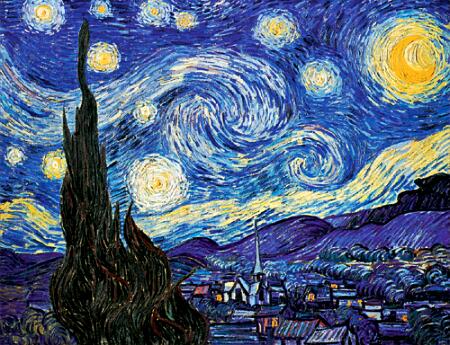
The painting was done from Van Gogh's memory and depicts the view outside his sanatorium room window at Saint-Rémy-de-Provence at night. It is one of Van Gogh's most famous works.
During Van Gogh's early life he wanted to dedicate his life to evangelization of those in poverty. Many believe that this religious endeavour may be seen in the eleven stars of the painting. In Genesis 37:9 the following statement is made: "And he dreamed yet another dream, and told it his brethren, and said, Behold, I have dreamed a dream more; and, behold, the sun and the moon and the eleven stars made obeisance to me."
3. The Dream - Pablo Picasso

The painting had to go through a $90,000 repair after Wynn, whilst showing the painting to some friends, accidentally put his elbow through the canvas, puncturing it in the left forearm of the figure and creating a six-inch tear.
4. Last Supper - Leonardo Da Vinci
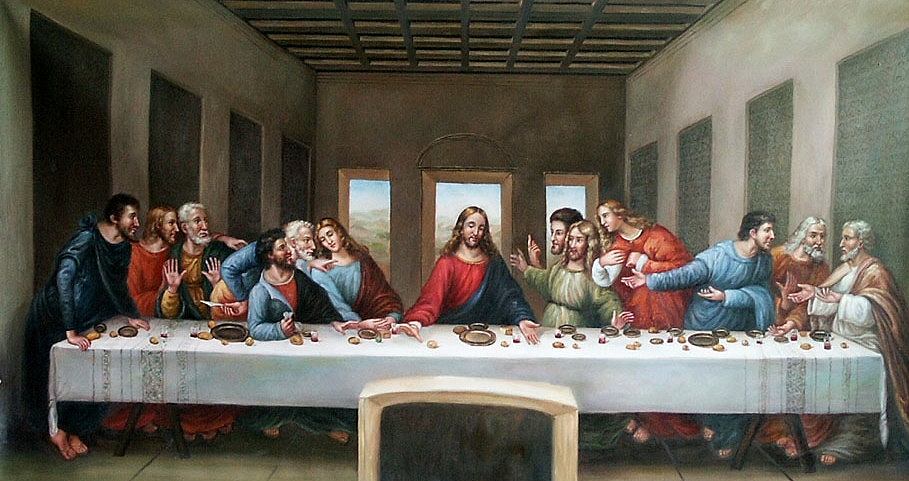
The painting covers an end wall of the dining hall at the monastery of Santa Maria delle Grazie in Milan, Italy. It is a large painting measuring 15 feet × 29 ft.
Leonardo started in 1495 and completed in 1498, although he did not continuously spend time painting it. However, there is speculation to the beginning date, as its uncertainty is arisen from the fact that archives and documents that could have given a more precise dating have been destroyed.
5. The Creation of Adam - Michelangelo

Where the hands meet in the middle, barely apart, the image has become one of the single most iconic images of humanity. Some say that the famousness of this segment of Michelangelo's fresco is only rivalled by that of da Vinci's Mona Lisa.
6. Girl with a Pearl Earring - Johannes Vermeer

This painting was not dated, it is unsure whether this work was ever commissioned. Very little is known about Vermeer and his artworks.
The most recent restoration of this painting was in 1994, and it was discovered that the black background is in fact intended to be a deep enamel-like green.
7. Guernica - Pablo Picasso
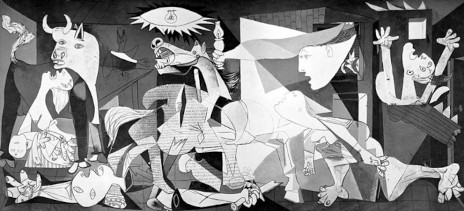
After its completion, Guernica was shown-off around the world on a world-tour gaining popularity.
Guernica conveys the sufferings of war and the grief it inflicts upon individuals, especially innocent civilians. Since then, Guernica has become an anti-war 'symbol' as it were and has considerably grown in status.
It is a very large painting displayed on a mural-sized canvas measuring 11ft x 25.6 ft.
8. The Scream - Edvard Munch

The painting has been the target of some high-profile thefts. This includes the theft in 1994, to which it was recovered several months later. And the one in 2004, where both The Scream and Madonna was stolen from the Munch Museum, being recovered two years later.
9. Luncheon of the boating party - Pierre-Auguste Renoir.

10. The Kiss - Gustav Klimt

The Kiss is renowned because of its tender representation of the female model who is tightly embraced within the overall geometry of the picture.
I don't claim ownership or credit for the pictures present, all credit is reserved for the original owners. No copyright intended, if you have an issue with a picture that is present, then please contact me. I am in no way profiting from the images that are present.
Senin, 11 Juni 2012
How to Improve your Maths
You might remember a while back when I posted an article called: Improve your mental maths, where I wrote about some simple tips to improve your maths mentally.
Looking back, there is a lot more to write about mental maths and I might publish a second blog post in the near future about more tips you can use.
At the moment however, I'm going to write about how you can get better at mathematics in general and not just in your head.
At the moment however, I'm going to write about how you can get better at mathematics in general and not just in your head.
For many people, maths is a dreaded subject simply because of the difficulty a lot of people find with it. It doesn't have to be though, and by using these tips, I'm sure your maths will start to see an improvement.
1. Practice
The main thing you can do which is going to help more than any other piece of advice on this list, is to practice, practice, practice. I can't stress enough how essential it is to practice. Whenever you see people who are good at something in particular; for example some who plays a musical instrument, won't have become brilliant overnight, things do take time and effort to see the results. This is no different for maths, so try to schedule yourself some time for it.
A brilliant thing you can do would be to incorporate maths into your daily life. For example: when shopping you could do the costs in your head, doing discounts and taxes, counting people and working out percentages of certain categories (like male:female ratio etc), and time maths - which incidentally could help with your time-management skills.
2. No calculator
I'm not stating that using a calculator is a bad thing to do as there are many instances where we cannot mentally calculate something. However, using a calculator too often will only get you more used to not doing the calculations for yourself. Sure, you're getting the answer - but do you really know how.
When you're next faced with a math problem, instead of whipping out the calculator and punching in the numbers, try doing it for yourself. Over time you'll start to see problems become easier to solve.
3. Learn the Multiplication table
The multiplication table is a really great resource to use for becoming better at maths. It helps with multiplication, division, and addition - but mainly multiplication. Start by learning individual number sets. For example; your three times tables, then your four times tables, then five, six, seven, and so on...
Use the 20x20 multiplication table, which at first may seem daunting, but by doing a bit each day though, it won't look anywhere near as scary as it first did. Don't forget to be patient, you won't learn the table over night. You've just got to remind yourself that persistence is the key.
4. Enrol in a math class
Whilst it is certainly within your capabilities to teach yourself maths and become quite proficient in the subject, there is nothing like having a teacher (someone who knows what they're doing) for help, instruction, and guidance.
A teacher will have a syllabus to stick to and will make sure that you get regular homework. Homework sounds bad and isn't everybody's favourite thing to do, but it does help you to cement things into your mind.
Going to the lessons will allow you to review maths fairy frequently as-well, so coupled with homework and revision, it should prevent rustiness.
It's also a great opportunity for you to get some one-on-one help and advice. The great thing about maths is that there are multiple ways of doing certain problems, meaning you can use the method that feels most comfortable for you. Maths teachers will be able to advise you of some of the more effective ways to deal with particular maths problems.
5. Learn math terms
Make sure that you get to grips with mathematical terms. Having an underpinning knowledge of these terms will allow you to grasp the relationships they have with each other a lot easier than someone who doesn't know what these terms are.
You don't have to learn all of them, but having an understanding of the common mathematical terms will be extremely beneficial for you. Some examples would be things like: average, circumference, diameter, area, volume, common denominator, cube root, factor, denominator and numerator, acute and obtuse angles, polygon, prime number, prime factor, radius, ratio, right angle, and whole number.
You don't have to learn all of them, but having an understanding of the common mathematical terms will be extremely beneficial for you. Some examples would be things like: average, circumference, diameter, area, volume, common denominator, cube root, factor, denominator and numerator, acute and obtuse angles, polygon, prime number, prime factor, radius, ratio, right angle, and whole number.
6. Use simple steps
When becoming familiar with a certain thing, try to organise a small, clear, simple set of instruction sheets for yourself to review and use. Using your instruction sheet, do a few practice questions. You'll notice that the more you do these questions and the more you refer back to your set of instructions - the easier and more ground into your mind it will become.
This will mean that when you come to doing these problems without your instructions to refer to, because of the practice you've been doing, you will already know the steps you are going to take to solve the problem, and won't need your instruction sheet anyway.
This will mean that when you come to doing these problems without your instructions to refer to, because of the practice you've been doing, you will already know the steps you are going to take to solve the problem, and won't need your instruction sheet anyway.
Compiling instruction sheets for individual problems and topics will be very beneficial for improving you maths. When you no longer need the sheets, don't throw them away. Keep hold of them and put them somewhere safe (like a folder) and review them from time-to-time. If you don't do maths frequently then you will start to forget how to do things, but having these clear set of instructions on-hand will mean re-familiarising yourself wont be too much trouble at all.
7. Write out problems
When solving problems, unless you're trying to become a lot better at mental maths, write down everything you do. This includes all formulae and working out. Make sure that it's not only written out in full, but that it is written neatly allowing you to know what's happening with a simple glance.
While it is a lot more tempting for you to skip over bits and do them in your head, only writing down the answers, it isn't nearly as beneficial for you as writing them down in full is. It causes you to slow down as you're having to take the time to write the problem out, and causes you to think about the problem more. It also defines them in your memory.
It's great for going back and checking answers as you're bound to have one or two (or more) wrong when learning. If you've done it in your head, how will you know where you went wrong - you won't. If however, you've written out all of your workings and the procedures you used, and it's clear to read - it will make finding and correcting your error a lot simpler.
8. Don't learn things late at night
I know there will be lots of people who smile at this, knowing to-well how hard it is to effectively learn something late at night. Your brain has been active throughout the whole day and at this time of night will want some rest, so by making it continue working when it's already fatigued, would not be doing yourself any justice whatsoever.
You'll find that you will start to notice small errors slipping into your process, which you know full well could have simply been avoided, but because your brain is tired, it's not able to tackle the problem all guns blazing like it normally would.
You'll find that you will start to notice small errors slipping into your process, which you know full well could have simply been avoided, but because your brain is tired, it's not able to tackle the problem all guns blazing like it normally would.
It's not uncommon to start feeling your eyelids getting heavier and heavier, and to start reading the same line two or three times before dropping off to sleep.
Mornings are the best time of the day for concentrating on something, when your body has recharged its batteries and is ready to face another day. You will notice a difference when studying early in the morning rather than studying late at night.
Summary
These are some simple effective tips that will definitely help you to see an improvement in maths, and if done frequently and properly, I can guarantee that an improvement will be made.
So to quickly sum up a few points: make sure you practice and review regularly, learn things when your concentration levels are high, write out the process you use, get yourself a teacher if possible, learn mathematical terms, try not to use a calculator where possible, learn the multiplication table, and make things simple for yourself. I hope this post has been of use to you. :)
Langganan:
Postingan (Atom)