Tampilkan postingan dengan label Exercise/Sport. Tampilkan semua postingan

Senin, 13 Mei 2013

30 Day Walking Challenge

In general as we get older we in turn start to do less and less exercise. As kids we are always wanting to be active and mobile but this wears off for many as we get older and other things take over as our commitments, leaving you not wanting to exercise or without enough time to do so.
People aged from 19 - 65 are advised to do two and a half hours of moderate exercise a week (walking for example), or 1 and a quarter hours of intense exercise (running for example) a week. 
With this walking challenge you'll be doing over double your advised exercise guideline.

Rules

1. You Must Complete the Daily Goal

This may seem like a very obvious rule as otherwise you fail the challenge if you don't complete the walking goals, however I feel like I should just make it clear that no exceptions can be made. If you are supposed to walk for 1 hour during the day and you walk for 59 minutes, although it may be tempting to allow yourself that, you shouldn't. 59 Minutes is not 1 hour and anything that is lower than an hour in length would mean failure if the challenge. 

The daily goal is a minimum set limit so anything that is lower than the minimum set goal is a fail, however, you may walk more than the daily walking plan if you so choose.

2. You Can't Split Walks up

You must walk the daily walking goal in one-go and may not split it up into segments. For example: If you are to have a goal to walk an hour in a day then you must complete this in one walk, you may not be allowed to split it up into (let's say for this example) 2 half-an-hour walks.

3. Walking Plan Choice

There is a choice from two walking plans. The first is a walking plan based upon a minimum set time you must walk for, the second is based upon a minimum set distance you must walk. Once the plan is chosen you cannot switch and must stick with that plan.

4. Ignore the Weather

You must carry this challenge out in whatever weather, so if it is pouring with rain so be it. Make sure suitable clothing is worn dependent upon the weather.

Walking Plan (Time)

Day 1: 1 Hour

Day 2: 1 Hour

Day 3: 1 Hour

Day 4: 1 Hour

Day 5: 1 Hour

Day 6: 1 Hour

Day 7: Rest

Day 8: 1 Hour

Day 9: 1 Hour

Day 10: 1 Hour

Day 11: 1 Hour

Day 12: 1 Hour

Day 13: 1 Hour

Day 14: Rest

Day 15: 1 Hour

Day 16: 1 Hour

Day 17: 1 Hour

Day 18: 1 Hour

Day 19: 1 Hour

Day 20: 1 Hour

Day 21: Rest

Day 22: 1 Hour

Day 23: 1 Hour

Day 24: 1 Hour

Day 25: 1 Hour

Day 26: 1 Hour

Day 27: 1 Hour

Day 28: Rest

Day 29: 1 Hour 30 Minutes

Day 30: 1 Hour 30 Minutes

Walking Plan (Distance)

Day 1: 4 Miles

Day 2: 4 Miles

Day 3: 4 Miles

Day 4: 4 Miles

Day 5: 4 Miles

Day 6: 4 Miles

Day 7: Rest

Day 8: 4 Miles

Day 9: 4 Miles

Day 10: 4 Miles

Day 11: 4 Miles

Day 12: 4 Miles

Day 13: 4 Miles

Day 14: Rest

Day 15: 4 Miles

Day 16: 4 Miles

Day 17: 4 Miles

Day 18: 4 Miles

Day 19: 4 Miles

Day 20: 4 Miles

Day 21: Rest

Day 22: 4 Miles

Day 23: 4 Miles

Day 24: 4 Miles

Day 25: 4 Miles

Day 26: 4 Miles

Day 27: 4 Miles

Day 28: Rest

Day 29: 6 Miles

Day 30: 6 Miles

Senin, 22 April 2013

30 Day Pushup Challenge

After posting the 30 Day Squat Challenge for the ladies, I thought it fair to post one for the men...so here it is: the 30 day pushup challenge.
Depending upon how good you are at pushups will determine which challenge I think you should go for. If you can do 0 - 25 I would suggest trying the beginners 30 day pushup challenge. If you are someone who can do 50 pushups or upwards then I would recommend trying the advanced 30 day pushup challenge. For anyone who falls within the 26 - 49 range I would leave up to you to decide which challenge you should go for, in fact however many pushups you can do it's up to you which challenge you take on - just try to stay realistic about your abilities and don't go so far as to injure yourself.

The challenge is based on a number of reps & sets for you to complete per day. Many people who know about reps and sets won't need this explaining to them but for those of you who don't it's not something that is hard to grasp. Basically a 'rep' stands for a repetition, so if I were to do 10 reps of pushups that would mean that I have done 10 pushups - 10 repetitions.
A set is a group of reps. For example if I were to do 2 sets of 10 pushup reps that would mean I did two lots of 10 pushups. 

Beginners Pushup Challenge (30 - 90 seconds rest in between each set)

The number of sets is displayed first before the number of reps followed by the total of pushups.

Day 1: 2 x 10 (20)

Day 2: 2 x 12 (24)

Day 3: 2 x 14 (28)

Day 4: 2 x16 (32)

Day 5: Rest

Day 6: 2 x 20 (40)

Day 7: 2 x 22 (44)

Day 8: 2 x 24 (48)

Day 9: 2 x 26 (52)

Day 10: Rest

Day 11: 3 x 14 (42)

Day 12: 3 x 16 (48)

Day 13: 3 x 18 (54)

Day 14: 3 x 20 (60)

Day 15: Rest

Day 16: 3 x 22 (66)

Day 17: 3 x 24 (72)

Day 18: 3 x 26 (78)

Day 19: 3 x 28 (84)

Day 20: Rest

Day 21: 4 x 12 (48)

Day 22: 4 x 14 (56)

Day 23: 4 x 16 (62)

Day 24: 4 x 18 (68)

Day 25: Rest

Day 26: 4 x 22 (88)

Day 27: 4 x 24 (96)

Day 28: 4 x 26 (104)

Day 29: 4 x 28 (112)

Day 30: 4x 30 (120)

Total = 1,546

Advanced Pushup Challenge (30 - 90 seconds rest in between each set)

The number of sets is displayed first before the number of reps followed by the total of pushups.

Day 1: 2 x 20 (40)

Day 2: 2 x 24 (48)

Day 3: 2 x 28 (56)

Day 4: 2 x 32 (64)

Day 5: Rest

Day 6: 2 x 40 (80)

Day 7: 2 x 44 (88)

Day 8: 2 x 48 (96)

Day 9: 2 x 52 (104)

Day 10: Rest

Day 11: 3 x 28 (84)

Day 12: 3 x 32 (96)

Day 13: 3 x 36 (108)

Day 14: 3 x 40 (120)

Day 15: Rest

Day 16: 3 x 44 (132)

Day 17: 3 x 48 (144)

Day 18: 3 x 52 (156)

Day 19: 3 x 56 (168)

Day 20: Rest

Day 21: 4 x 24 (96)

Day 22: 4 x 28 (112)

Day 23: 4 x 32 (128)

Day 24: 4 x 36 (144)

Day 25: Rest

Day 26: 4 x 44 (176)

Day 27: 4 x 48 (192)

Day 28: 4 x 52 (208)

Day 29: 4 x 56 (224)

Day 30: 4 x 60 (240)

Total = 3,104

Kamis, 18 April 2013

30 Day Squat Challenge

Quite recently there has been a challenge for women floating around the web that has gained much interest. It seems to becoming more and more popular, having Facebook, Tumbler, and other website pages devoted to it. I first heard about this challenge through my sister who decided to take it up, in fact it was yesterday she started. After hearing it from my sister I also found out that 3 female colleagues from work, well actually 2 colleagues as 1 of them has now got another job, so 2 colleagues and 1 ex-colleague has taken up this 30 day squat challenge. 
I hear that it is quite the challenge so prepare for some hard work!
So here is the plan:

Day 1: 50 Squats

Day 2: 55 Squats

Day 3: 60 Squats

Day 4: Rest

Day 5: 70 Squats

Day 6: 75 Squats

Day 7: 80 Squats

Day 8: Rest

Day 9: 100 Squats

Day 10: 105 Squats

Day 11: 110 Squats

Day 12: Rest

Day 13: 130 Squats

Day 14: 135 Squats

Day 15: 140 Squats

Day 16: Rest

Day 17: 150 Squats

Day 18: 155 Squats

Day 19: 160 Squats

Day 20: Rest

Day 21: 180 Squats

Day 22: 185 Squats

Day 23: 190 Squats

Day 24: Rest

Day 25: 220 Squats

Day 26: 225 Squats

Day 27: 230 Squats

Day 28: Rest

Day 29: 240 Squats

Day 30: 250 Squats

A useful motivational and tracking technique you can use to go alongside this would be the 'Don't Break the Chain' technique.
 

Jumat, 24 Agustus 2012

How to Create an Exercise Plan

Setting yourself the challenge to exercise regularly can seem like a daunting goal. Not knowing where to start or which exercises to do, and can be off-putting before you've even begun. A lot of people who exercise regularly will have faced this at the start and many of them have an exercise plan set in place to allow them to consistently get the exercise their body needs. For these people, their exercise plan is usually already in their heads as they've got into a routine, but for anyone who's just starting to exercise (maybe you who's reading this post), then an exercise plan would be a good thing to set in place.

1. Determine the amount of time available

It's no good setting yourself the goal of exercising an hour a day if you only have 20 minutes to spare. When you first start an exercise plan you'll want to determine straight away how much time you have to spare. Then once you've done that you can then decide what exercises to do.

You may have 20 minutes as a whole to spare a day but that's 10 minute sessions at two parts of the day, and that's fine. A workout plan doesn't need you to do your whole workout for the day in a single session, breaking it into chunks will make it more manageable anyway - especially when first starting out.

If you don't have enough time in the day to manage an exercise session then there are things you can do to make time. For example: you may decide to get up an hour earlier to allow yourself 30 minutes of exercise. Or, if you go to work, decide to cycle to work - which can count as your exercise for the day, depending upon how long it is for you to cycle. If it's only five minutes, you may want to consider finding time to do some more. Just look where you could spare some time - you may be surprised. 
If you want to know how you can get up earlier, here's a previous post of mine 'How to get up Early in the morning'.

2. Decide what exercises you're going to do

When creating an exercise plan you'll want the right kind of workout for you. If you're looking to lose weight, then cardiovascular exercises are the best things to go for. Doing cardio boosts your metabolism to help burn fat quicker and helps to promote a healthy heart helping in the prevention of heart diseases and strokes.

If you're wanting to gain muscle then you would do a muscle workout. Muscle workouts also help to burn fat because increasing muscle will also help to speed up metabolism - not to the same extent that cardio does though. Although, having muscle does help burn fat quicker because there is less space for the fat to be - that's not to say that just doing muscle workouts will help you lose all the weight you want because it wont and that's where cardio is required.
You may decide to do a mixture of both cardio and muscle exercises.

If you're wanting to do cardio exercises then it's normally best to do them most days or everyday. It's alright if you can't do it everyday - it's your exercise routine. 

Examples of cardio exercises:
  • Running (probably the most popular cardio exercise)
  • Swimming
  • Walking
  • Dancing
  • Skipping rope/Jump roping
  • Cycling
 Examples of muscle exercise:
  • Glutes and hamstrings - Knee to chest, hip raises, split squats, step-ups.
  • Triceps, chest and shoulders - push-ups, chair-dips, bench press,
  • Abdominals and lower back - Leg raises, cycles, crunches, mountain climbers, jumping knee tucks
  • Forearms and biceps - pull-ups, inverse body weight rows,
  • Quads - Squats, lunges, heel slides, wall slides, backward drag, alternate leg diagonal bound, frog hops, standing hip flexors.
There are many more cardio and muscle exercises that you can do, these are just some examples to give you an idea. If you decide to do muscle exercises then it's best to do them every 2-3 days (48-72 hours) to give your muscles time to expand and repair.

3. Consistency

Now when I'm talking about consistency I'm talking about two things. The first is how often you're going to exercise and the second is at what time.

If you don't have much time to spare during your busy week you may decide to do 30 minutes of exercise every other day or if you're really pushed for time maybe just once or twice a week. The main thing is the consistency of the exercise. Our bodies like routine and so by being consistent with your exercise will not only allow your body to adapt naturally, but also carve out a scheduled space in your life in which you set aside specifically for exercise. People who are consistent with their exercise are much more likely to stick to it than that of an inconsistent person.

Also applying a time of day is helpful to make a much more specific exercise time, and if consistent, will help you to stick to it even easier. For example: you may decide that every week-day you're going to jog for half an hour. The only thing is, not only do you have work during the day, but you also have family commitments afterwards. You may then decide that waking up an extra hour earlier in the mornings will give you time to go for a 20-30 minute jog and be back in time for when you would usually wake-up. So, the mornings at, let's say for example 6:30, you leave the house to go for your 30 minute jog.

A quote I mentioned in my 'don't break the chain' article was "consistency breeds momentum", and it really does.

4. Keep a record of what you do

When you're caught-up in your exercise sessions it can be easy to not keep track of what you do and how long for. Also, because strenuous exercise can get exhausting it can be easy to over-exaggerate or under-exaggerate the amount of time used up.

This is where keeping a record of what you do is useful. Make a mental note of when you start and when you finish write down how much time has passed. Over time you will be able to compare these workouts with each other and will be able to make slight adjustments.

Try to record how much you do in terms of exercise as well, distances or repetitions. For example: I ran to the park and back today, I did 50 push-ups, I cycled a mile, etc.    

Conclusion

When first creating an exercise plan it may seem like an alien concept, and you may find it challenging - this is normal. Don't start off too ambitious. Create a manageable plan, and if it is too easy and not challenging enough for you, make the changes to it that will make it that bit harder. The best thing to do is to stick to it, and before you know it you'll have worked exercise into your daily life. Good luck. 

Update: If you have an iPhone, then you can get some useful apps to help your workout. 

Selasa, 21 Agustus 2012

How to Lose Weight

Obesity rates are on the rise. People want to know how to lose weight, and some are trying to, however, society is not letting them. This is as society is putting more and more obstacles in the way of losing weight. It now seems that it is wrong for our bodies to ever feel hunger, but really this is totally normal and our bodies are equipped to handle this.

There are so many advertisements around telling you about these unhealthy foods and how you need to try them and mentioning how cheap they are. And in comparison, unhealthy foods are relatively cheap, whilst the healthier options (for instance: fruits and veg) are a bit more on the pricey side. That's not to say that it's only because of society that a person is overweight, that's not true, there can be many factors that contribute towards a persons weight. These tips are known to work it's just making sure that you stick to them.

1. Exercise

Exercise is essential for wanting to lose weight. Exercise is great for helping shed those calories and helps to speed up metabolism, which is what burns the majority of calories. Adults are recommended to do at least 30 minutes of moderately intense exercise 5-7 days a week, whilst overweight and obese people should aim for 60 minutes and upwards.  
There are so many different forms exercise can take, so there should be one for you somewhere. That could be in the form of swimming, cycling, running, etc.

You may be thinking "I don't have 20 minutes to spare, let alone 30 minutes or more". Well this is common for many people, but the good thing is you can break it up into smaller chunks as long as you manage to hit your guideline for the day. For example, you may decide to do a 10 minute walk to work and a 10 minute walk back from work. That then only leaves the remainder of your time to spend doing something else. 

Try adapting to a more physically engaging lifestyle; try walking instead of taking the car or bus, or take up cycling, take stairs instead of lifts, take regular short-session intervals for something as small as 5 minutes of activity. Maybe even join a club. Over time it really does do your body good. 

2. Drink water

What you drink also plays a vital part in weight reduction as well, so sugary drinks are best to be avoided. If you like to enjoy an alcoholic beverage then try to limit the amount you have or stop completely. Water is the best liquid to go with and helps with metabolism. In fact one way to see a reduction in calorie consumption is simply to switch to water as being your 'main drink'.  
You can read more about drinking water here: 10 Reasons for Drinking Water.

3. Eat healthier

Eating healthier is something that, if you're serious about weight loss, will need to be implemented into your life. The truth is that your body needs vitamins and minerals to help sustain it and keep it functioning properly, not to mention helping with metabolism. 

Sugary foods and fatty foods are the big contributors to weight gain so cutting these out of your diet, or at least limiting their intake will definitely be beneficial.
If possible, try and get your recommended 5-fruits-and-veg a day. They are very low in calories and are great for snacks. 

4. Watch your calorie intake

You're body naturally burns calories, the majority is done through sleeping, but it is affected about what you do during the day. If you're consuming more calories per day than your body is burning then you are inevitably going to gain weight and not lose it. A lot of people who are doing this will not even realise the amount of calories they're taking in. When I started to have a look on the nutritional labels on the sides of food packaging, I was shocked about how easy it is to consume more than your daily calorie intake-guideline. Healthier foods seem to be lower in calories and so are the ones to go for, and they provide a steady energy use throughout the day.
Men's guideline intake of calories is 2,500. Women's calorie intake is 2,000 per day. 

5. Don't suddenly change your lifestyle

Your body will not adapt well to all of these sudden changes if you drastically change what you're doing. When wanting to train-up for a marathon without having any running experience, you don't just start by trying to do 26 miles. You slowly build up to that, maybe only starting with half a mile until your body has adapted to the change you are making.
So with trying to lose weight, for a lot of people anyway, a gradual change should be made so as to adapt better to the changes. This will keep you more inclined to keep these new good habits.

It's definitely possible to make a lot of big sudden changes and stick with them, however, only more disciplined people can do it this way. It is the quickest way though, but the way that isn't normally stuck to with most people.

If you do decide to start by making a gradual change to your lifestyle, don't let your self make excuses and allow lots of bad habits to continue because your making a gradual change. The emphasis shouldn't be on the gradual (because that could cause you to be very gradual about the process) but on the change, which is after all what you're after. Also a gradual change doesn't mean that you can't set challenging goals, just not as big as a full-blown lifestyle turn-around.  

6. Eat breakfast

Despite the rumour floating around that avoiding breakfast is good for you - it's not. Breakfast is essential for kick-starting your day and providing you with the energy your body needs. Whilst you sleep your metabolism will slow down and by having breakfast in the morning will help to get it going for another day. If you do miss breakfast you can lose fat, however, your body can also start to break down muscle as a a source of energy and that's not good. Having more muscle will mean there is less space for fat (if you don't eat excessively and do exercise) and actually helps with the promotion of a healthy metabolism, making burning fat easier.

7. Stop snacking

This is where a lot of people trip up and I can see why. Snacking is an incredibly easy thing to do, especially when you're bored or have had a stressful time - acting as comfort food. When people change their diet, often they seem to forget about snacking and it seems that one or two biscuits here and there won't hurt - but they do. Unhealthy snacks (such as biscuits, chocolate, sweets, and the like) are all high in calories and sugar, and will prevent you from losing as much weight as you could, if at all. 
I've written a post about snacking named: How to Stop Snacking. 

8. Keep a food diary

This is just to let you know what your calorie consumption is for each day. What you will need to do is to record the day's date and then record everything that you eat as your day goes along - and I mean EVERYTHING. Do not let anything get missed. If you want a truly accurate total of the calories that you consume then it is vital that you do not miss anything. Make sure to record saturated fat contents and sugar contents for each thing that you eat as-well, as these all contribute towards putting on weight. Your recommended daily sugar intake should be no more than 120g (for men) and 90g (for women). Saturated fat intake should be no more than 30g (for men) and 20g (for women).

Conclusion

Weight loss is not something that will happen overnight but is something that you will have to adapt to for the long term. If you are wanting to see serious results then you will need to adopt all of these tips and then have the self-discipline and motivation to stick to them. If you can afford to, getting a personal trainer who knows what they're doing will help you to keep to your goal. Good luck.

Selasa, 10 Juli 2012

Top 10 Olympic Events

I love to play sport, and more so, I love to win - I suppose it's my competitive nature. When it comes to watching sports, I'm not the most avid watcher. I mean don't get me wrong sports are very interesting to watch, but I'm not fussed if I miss a big sporting final, I'll watch it if it's on and I decide that I'm going to watch t.v, but as far as following particular sports, I'm not bothered. With something like the Olympics though, I know I will watch it, not all of it, but the parts that interest me. And with so many events to choose from, it's never boring. This list is based on the research I have conducted and slightly on my own opinion. The list is in no particular order. Hope you enjoy. :)

1. Cycling
Cycling, or more specifically velodrome cycling, is a very popular Olympic event. A velodrome is a cycling track designed for high speed cycle races. Modern velodromes are designed in the shape of a oval, having 180 degree bends at either end and steep sloped edges. It was international events, such as the Olympic Games that led to standardisation of velodromes. An Olympic velodrome must measure 250m.

2. Athletics
Athletics is another very popular Olympic event, that consists of a variety of different sports. These include; race walking, track and field, cross-country, mountain running, and road running. With the exception of relay racing, athletics is an individual sport, with organised athletics being able to be traced back to the ancient Olympics.
For a standard outdoor running track, it will consist of 8 lanes (1.2m in width), and will be 400m in length, being the shape of a stadium.

3. Swimming
Swimming is the third event to appear on this list, and rightly so. In the Olympics, athletes taking part in this event, will be swimming in what's known as a 'long course pool', which is the name given to a pool being 50m in length.
Swimming has the second largest number of events after athletics. The first four Olympics would see swimmers swim in open water, for example in the year 1896 it was the in the Mediterranean sea.

4. Triathlon
Credit: JKrabbe
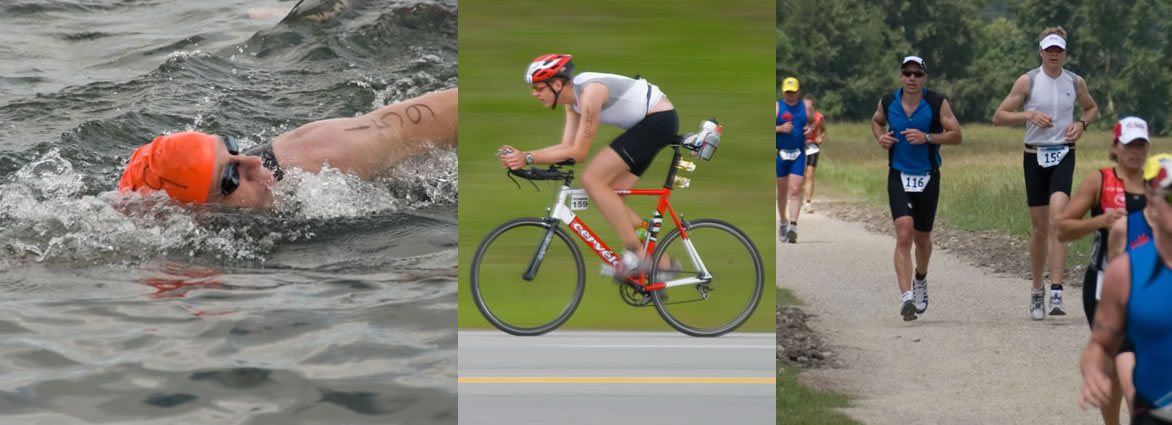
The triathlon is a race consisting of three different sections: running, cycling, and swimming. After each section is finished an area called the transition stage occurs, where athletes must try and transition from one event to the next. For example, after swimming, athletes must remove their wetsuits, put on their cycling shoes get on their bike and sort out their helmet. This is whilst the race is still on. After the cycling, athletes must then transition from cycling to running. Sometimes it's these transition sections that make or break a race.
A standard Olympic triathlon will have 1.5km swimming, 40km of cycling, and 10km of running.

5. Sailing
Sailing is the sport of racing boats without the aid of an engine. Using the boats sails, sailors manage to use the wind for propulsion. The Olympics will hold sailing events in areas where no other boats will be allowed to access whilst the race is on.
Every sailor must know how to and carry out a proper lookout at all times, adjust speeds to suit the conditions, and know whether to 'stand on' or 'give way' in any close-quarters situation.

6. Taekwondo
Taekwondo is the national sport of South Korea and has gained international popularity over the years. It has been an Olympic event since the year 2000.
The martial art combines a mixture of combat fighting, self-defence, sport, and exercise. It is one of the world's most popular martial arts.
Taekwondo is known for it's emphasises on kicking, the rationale being that the leg is the strongest weapon that our bodies have.

7. Equestrian
Equestrian is the sport of horseback riding, more specifically referring to the skill of riding, driving, steeplechasing or vaulting with horses. The practice of horseback riding is not only used for sport, but also as a recreational activity, a mode of transport, and for working purposes. 
Equestrian first made its appearance in the Olympics in 1900, disappearing then until 1912. All riders wishing to take part in the event must be 16 years or older and be riding horses that are 7 years or older. There is no maximum age requirements.

8. Gymnastics
credit: Chen Ming/Xinhua
Gymnastics is another popular event and is the performance of exercises that require physical strength, flexibility, agility, coordination, and balance. The Ancient Greeks would perform a form of gymnastics where individual athletes would perform some type of athletic feat according to that said individual, of course at lot has changed since then. 
Gymnastics appeared in the 1896 Olympics, and by 1954 the event had been standardised.

9. Wrestling
Wrestling is a physical contact combat sport where participants use forms of grappling techniques, throws, take-downs, pins, and the like, to defeat an opponent. Victory is normally shown through a wrestler showing physical superiority over his/her opponent. 

During the Ancient Olympics of the Greeks, wrestling was a brutal sport but was also the most popular. The Romans also decided to participate in wrestling events of their own, removing much of the Greeks brutality. The first competition to appear in the modern Olympics was that of 1904.

10. Volleyball
Volleyball is the last sporting event to make the list, and is a fun sport to play if you ever have the chance. It has been apart of the Olympics since 1964. It is the national sport of Sri Lanka. It is a team event where each team (consisting of 6 players) must try to ground the ball on the opposing teams side, having first hit the ball over the net.
A standard volleyball court is 18m long x 9m wide, divided into 9m x 9m halves by a one-meter (40-inch) wide net. The top of the net is 243 cm from the ground, 224cm for the women's event.

I don't claim ownership or credit for the pictures present, all credit is reserved for the original owners. No copyright intended, if you have an issue with a picture that is present, then please contact me. I am in no way profiting from the pictures that are present.

Jumat, 06 Juli 2012

The Olympic Games

What is the Olympic Games

The Olympics. It's the biggest international sporting event there is taking place around the world. With the Olympics being held here in my home country England, London (not my home city). I thought it would be fitting to write a bit about the Olympic games that every professional athlete strives for.

Being an International event, only the best competitors from each participating country are accepted with the standards incredibly high.  More than 200 nations compete. So imagine that you're an athlete that has been accepted into the Olympic games, and let's say that there are two people from every nation competing in your event. If there's 200 or more nations that compete, you've already got at least 399 (including one person from your own country) competing for gold medal. That's a lot of competition. Especially as the slightest of errors will cost you winning. Sort of like the chaos theory, small factors taking affect on the ending result.

The Olympics is split into two events, the summer event, and the winter event. Both of these take place at a two year interval to each other, meaning it's a four year period for either the summer or winter to take place again. E.g: 2012: summer, 2014: winter, 2016: summer, 2018: winter...

The 'International Olympic Committee' (IOC) is the governing body of the Olympic games being founded by Baron Pierre de Coubertin in 1894. The origins of the Olympic games did not start with Baron, but was in fact held in Olympia, Greece, from 8th century BC to the 4th century AD.

Variations of the main Olympics have been created during the 20th and 21st centuries. This includes the creation of the winter Olympics, the Paralympics, and the Youth Olympic Games.

The Winter Olympics was invented for the inclusion of ice and snow events that were impossible to do during the summer events. The events that are included are: alpine skiing, biathlon, bobsleigh, cross‑country skiing, curling, figure skating, freestyle skiing,  ice hockey, luge, Nordic combined, short track speed skating, skeleton, ski jumping, snowboarding, and speed skating.

The Ancient Olympics

The Ancient Olympics were based upon myth, and thought it was to hold honour for Zeus. Because of the nature of the Greeks, much of the origin of the Olympics is shrouded in mystery. There are many different mythological stories to how the Olympics first began, but historical records suggest that it began on 776 BC and ended 394 AD, this was due to Theodosius I banning the games. The games, like today, were held every four years.
The Games became a political tool used by city-states to assert dominance over their rivals.

During the middle day of the games, 100 ox would be sacrificed to the Greek god Zeus. City-States relied heavily on their neighbours for political and military alliances, on the other they competed fiercely with those same neighbours for the resources necessary to sustain life.
If a City-state did well at the Olympics and did well consistently, the population would grow as a new desire to live their would increase. The Olympics weren't just about sports like it is today but was used as an opportunity for cities to show their power over others, giving them a political advantage over allies.

The 1896 Games

The 1896 Games were the first games to be hosted by the IOC and were the first Olympic games since the 4th century AD. It was hosted in Athens, Greece, inside the Panathenaic Stadium. 14 Nations competed, 241 athletes, and 41 events.

The Greek officials and public were enthusiastic about the experience of hosting these Games. This feeling was shared by many, and it was even considered that the games should be held in Athens permanently. However the IOC did not agree, they wanted the Olympics to be an International event, and so thought best to rotate internationally, the second games were held in Paris.

Minggu, 10 Juni 2012

How to Increase Stamina

Every one of us has a set level of stamina that our bodies use when being active. We need it to help keep us active and people who have low levels of stamina will find it difficult to remain active for longer periods of time. 

However, stamina levels are not set in stone, and can be improved with a few simple steps. 
If you're planning to get in better shape and are wanting to start exercising more seriously, maybe entering yourself into some endurance events, then stamina is essential.
Here are some steps to follow to help increase stamina.

1. Exercise

One of the best things for you to do to increase stamina is to exercise. Which is ironic as you need stamina to exercise for any given length of time.

The best thing to do to make sure that you start to exercise more, would be to organise yourself a schedule and then stick to it. Plan it so it suits you, this may be in the form of jogging every morning at 6am?, or maybe rowing for 30 minutes at the gym every day at 17:00?, whatever works for you do it and stick to it. 

If you like the sound of exercising early in the morning or are struggling at getting up early in the morning, then here's a previous post of mine: How to get up early in the morning.

Over time, your body will make physical improvements, and you'll notice that the exercise (for example swimming) that you could only do for 5 minutes when you first started, is now able to be performed for 30 minutes. Basically, cardiovascular exercises are the best for improving stamina.

2. Eat healthy

Eating a healthy and well balanced diet is not only good for stamina, but for your body in general. Make sure that you eat those fruits and vegetables, and include lean meats. 
Lean meats are meats that don't include a lot of fat. Some examples of lean meats would be turkey and chicken.

3. Drink plenty of water

As well as eating healthy, you will also need to drink healthier. It's no good watching what you eat and then letting yourself drink loads of alcohol and fizzy drinks - you have to both eat and drink healthy.
I've written a previous article titled: 11 tips to drink more water for those of you who struggle to drink enough water during the day, it's very easily done.

Summary

This post has been a bit of a shorter one, but there's really not that much more to say about how to improve stamina. As long as you exercise, eat and drink healthily - you'll see big improvements as time goes by.

Sabtu, 09 Juni 2012

10 Very Famous Basketball Players

I've never been that good at basketball, football has always come easier to me, however I do have an interest for the game. Not that I would watch it on t.v, I don't really follow sports on t.v, but nevertheless the sport does interest me.
I think that basketball takes skill to play and the very famous basketball players that are on this list, are obviously here for a reason - because they are recognised for their talent. 
Here's my list of 10 very famous basketball players, hope you enjoy. :)

1. Michael Jordan
Michael Jordan mid-leap
Height: 6ft 6in

Michael Jordan (born 17 February 1963) is considered by many to be (or to have been, as he's retired) the best basketball player in the history of basketball. The popularity of the NBA during the 1980's and 1990's is partly down to Michael Jordan and the marketing involved in promoting the athlete and the game of basketball.

Michael Jordan was remarkably talented and when he wanted to score, there wasn't really anybody who could stop him in the game. To get an idea of how good this guy was, here are his notable awards: he's a 6-time NBA champion, 5 MVP awards, 10 All-NBA First Team designations, 9 All-Defensive First Team honours, 14 NBA All-Star Game appearances, 3 All-Star Game MVP awards, 10 scoring titles, 3 steals titles, 66 NBA Finals MVP awards, and the 1988 NBA Defensive Player of the Year Award, and he holds the NBA records for highest career regular season scoring average (30.12 points per game) and highest career playoff scoring average (33.45 points per game). 
He is also only 1 of 2 players to have ever broken through the 3,000 point mark in a single season, the other being Wilt Chamberlain.

2. Wilt Chamberlain
Wilt Chamberlain
Height: 7ft 1in

Wilt Chamberlain (August 12, 1936 - October 12, 1999) was an American basketball player. He is considered one of the greatest players of all-time. Chamberlain himself considered himself to be the best player of all-time, and with his numerous awards and records, it's not surprising to see why he was so confident.

He is the only player to score 100 points in a single NBA game or average more than 40 and 50 points in a season, he won 11 rebounding titles, won 7 scoring awards, 9 field goal percentage awards, was a 2-time NBA champion, 4 Most Valuable Player awards, the Rookie of the Year award, one NBA Finals MVP award, and being selected to 13 All-Star Games and 10 All-NBA First and Second teams.
He is the only person to have broken the 4,000 point barrier (points in a single season), and the 3,000 point barrier.


3. Magic Johnson
Magic Johnson
Height: 6ft 9in

Earvin Magic Johnson (born August 14, 1959) was an American basketball player who played point guard for the Los Angeles Lakers of the NBA. He was selected by the Lakers in the 1979 NBA draft after winning championships in high school and college. He had a notorious rivalry and friendship with Celtics player Larry Bird who he faced in the 1979 NCAA finals and three NBA championship series.
He is a 5-time NBA champion, winner of 3 NVP awards, 12 all-star games, and 10 All-NBA First and Second Team nominations.

He retired immediately in 1991 after announcing that he had been diagnosed with HIV/AIDS, but came back in the 1992 All-star game, winning another NBA MVP award. He retired again for four years, returning in 1996 to play 32 games, before retiring for the third and final time. Johnson has been an advocate for HIV/AIDS prevention and safe sex.

4. Larry Bird
Larry Bird
Credit: Lipofsky
Height 6ft 9in

Larry Bird (born December 7, 1956) was an American basketball player who played for the Lakers, and had a renowned rivalry with basketball player Magic Johnson. The two players played off against each other in numerous matches and finals, grabbing viewers attention. 
Their rivalry has been compared to that of Bill Russell and Wilt Chamberlaine.

Bird had a poor childhood, his family living close to poverty. Later on in life though, Bird stated that his poor financial upbringing still motivated him till this day.

Bird retired in 1992 due to chronic back problems. At his retiring ceremony, Magic Johnson stated that "Bird is a friend for life".

During his career, Bird won: 3 NBA championships, 3 NBA MVP's, was a 12-time NBA All-star, 2 NBA final MVP's, 3 Three-point Shootout champion, and voted to the NBA's 50th Anniversary All-Time Team.

5. Yao Ming
Yao Ming
Height: 7ft 6in

Yao Ming (born September 12, 1980) was a Chinese professional basketball player who became one of China's most popular athletes. He is well-known for his towering height, and during his last season, was the tallest active player in the NBA. 
During his rookie year, a documentary was made called: 'The Year of  the Yao'.

During his career Yao has been awarded: 8 time NBA All-star player, 2 time All-NBA Second Team player, 3 time All-NBA Third Team player, and reached the NBA playoffs 4 times.

6. Bill Russell
Bill Russell
Height: 6ft 9in

Will Russell (born February 12, 1934) was an American professional basketball player who played centre for the Boston Celtics. He is widely regarded like most of the players on this list, to be one of the all-time greats of basketball history.

Russell's excellent shot-blocking and man-to-man defense were major reasons for the Celtics' success, which inspired other team members to up their defensive play.

Russell is an 11 time NBA champion, 5 time MVP, 5 time NBA rebounding champion, a 12 time NBA All-star player, 3 time All-NBA First Team player, and 8 time All-NBA Second Team player.

The NBA announced in 2009 that the NBA Finals MVP trophy would be renamed the Bill Russell NBA Finals Most Valuable Player Award in honour of Russell.

7. Kareem Abdul-Jabbar
Magic Johnson and Kareem Abdul-Jabbar
Height: 7ft 2in

Kareem Abdul-Jabbar (born April 16, 1947) was an American professional basketball player and is the NBA’s all-time leading scorer, with 38,387 points. At the time of his retirement, Kareem was the NBA’s all-time leader in points scored, games played, minutes played, field goals made, field goal attempts, blocked shots, defensive rebounds, and personal fouls.

During his high school years, Kareem helped his team win an impressive 71 games in a row. 

He has won 6 NBA championships, 6 NBA MVP's, 2 NBA Finals MVP, is a 5 time All-NBA Second Team player, is a 5 time NBA All-Defensive First Team player, and is a 19 time NBA All-star player.

8. Shaquille O'Neal
Shaquille O'Neal
Height: 7ft 1in


Shaquille Rashaun O'Neal (born March 6, 1972) was an American professional basketball player and current analyst on the television program Inside the NBA. 

Weighing in at 325 pounds, he was one of the heaviest players to ever play in the NBA. Rashaun O'Neal would often use his size and strength to overpower his opponents for rebounds and points.
It was because of his size, strength, and obvious talent, that elevated Rashaun O'Neal to become one of the best centres in the league.


Rashaun O'Neal has won 4 NBA championships, 3 NBA finals MVP's, an NBA MVP, and NBA rookie of the year. He is also a 15 NBA All-star player, a 2 time NBA scoring champion, an 8 time All-NBA first team player, an 2 time All-NBA second team player, and an 4 time All-NBA third team player.

9. Kobe Bryant
Kobe Bryant
Kobe Bean Bryant (born August 23, 1978) is an American professional basketball player who plays shooting guard for the Los Angeles Lakers of the NBA.

Bryant was a recognised talent during his high school days and was seen as the best high school basketball player in the country. When Bryant entered the NBA, he quickly earned himself the reputation as a "high flyer".

Bryant and Shaquille O'Neal led the Lakers to three consecutive NBA championships from 2000 to 2002.
Bryant managed to score 81 points during a game against the Toronto-Riders, which is the second-highest score in a single game - second to Wilt Chamberlains record-holding score of 100.

Bryant has currently won 5 NBA championships, 2 MBA finals MVP's, an NBA MVP, and is an 14 time NBA All-star player, a 2 time NBA scoring champion, a 10 time All-NBA first team player, a 2 time All-NBA Second Team player, a 2 time All-NBA third Team player, and an NBA Slam Dunk Contest championship.

10. LeBron James
LeBron James
Height: 6ft 8in

LeBron James (born December 30, 1984) is an American professional basketball player of the NBA. 
Whilst still a sophomore at St. Vincent – St. Mary High School, James was highly promoted by the media as an upcoming NBA superstar. He has been nicknamed 'king James'.
Since joining the league, James has set a number of youngest player records.

He has been a member of the USA national team, winning a bronze medal at the 2004 Olympics and gold at the 2008 Olympics.

So far during his career, James has won 3 NBA MVP's, NBA rookie of the year, NBA scoring championship, and is an 8 time NBA All-star player, a 6 time All-NBA First Team player, a 2 time All-NBA Second Team player, and a 4 time NBA All-Defensive First Team player.

I don't claim ownership or credit for the pictures present, all credit is reserved for the original owners. No copyright intended, if you have an issue with a picture that is present, then please contact me