Tampilkan postingan dengan label Animals. Tampilkan semua postingan

Selasa, 03 Juli 2012

Top 10 Heaviest Land Mammals

Top 10 Heaviest Land Mammals. Roaming around on the Earth are some truly enormous animals. Some that you wont be able to get a grasp on until you see them in person. Now to look at, there may be animals you feel should have appeared on this list or the ordering of this list should have been different, but from the research I've done, the animals that appear here do seem to be the heaviest land mammals on the planet. 

Because it's difficult to get a completely accurate weight for all of these animals, we can't ask an elephant or rhino to stand still on a set of scales, there may be slight inaccuracies with the figures. However, they should all be within a close range of the real weight, research done has been able to get some remarkable results about these mammals.

1. African Elephant
Weight: 4,700–6,048 kg

The African Elephant is the largest and heaviest land mammal on Earth. It has enormous ears that it uses for heat loss, and huge tree trunks for legs, which isn't surprising when they have to uphold their huge body. 
Males stand at a staggering 10-13 ft at the shoulder, and while they may seem like gentle giants, people who know elephants will know not to get to close to one, they have been known to charge people, especially with young, and can bring down trees with ease.

2. Asian Elephant
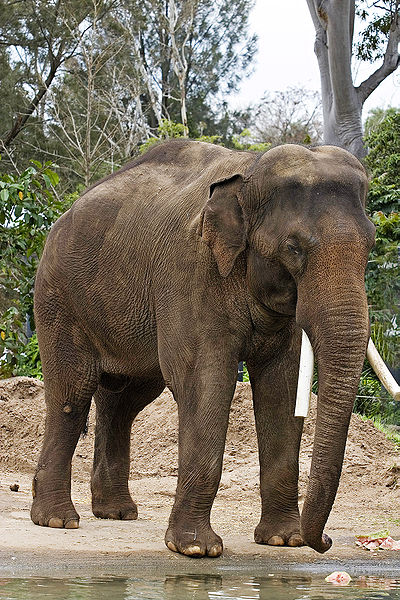
Mass: 4,500 - 5,400 kg

The Asian elephant is the second heaviest land mammal in the world, behind its relative the African elephant. In the last 26 years the Asian elephant has been considered to be an endangered animal, as population levels have decreased by 50% in the last 60-75 years. There was an exceptionally large bull Asian elephant living in captivity which weighed a huge 6,590 kg!
The trunk of this animal serves as an arm for the elephant and contains as many as 60,000 muscles, allowing for a surprisingly amount of dexterity.

3. White Rhinoceros
Credit: Zhand38
Mass: 1,360 - 3630 kg

The white rhinoceros is the largest of the five species of rhinoceros, and is one of the non-extinct species. The largest recorded white rhinoceros was a male weighing 4,500 kg. 
The front horn on it's snout, the larger of its horns, averages at around 90cm but can grow to 150 cm (which is just under 5ft).

The northern white rhinoceros is much rarer than the  southern white rhinoceros, with all of the species now in captivity.

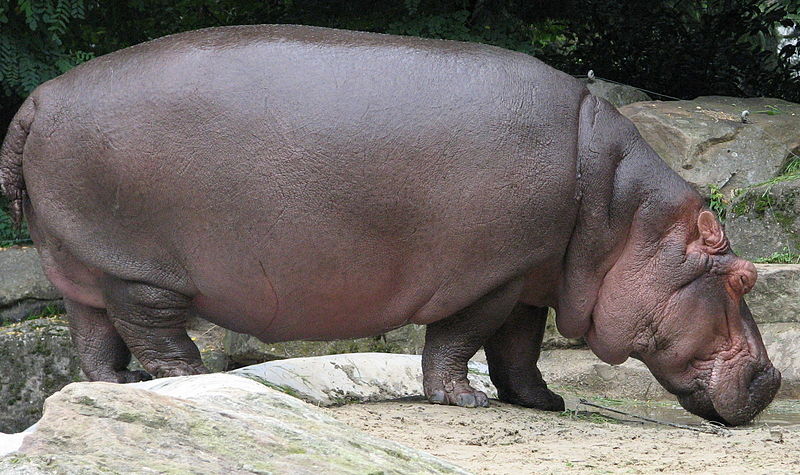
4. Hippopotamus
Credit: Pbrundel
Mass: 1,500 - 1800 kg

The hippopotamus, or simply the hippo, is the third largest animal to appear on this list, behind elephant and rhinoceros. The hippopotamus is often regarded as the most dangerous animal in Africa. It may not look as ferocious as a lion but have been known to kill people who gets too close, that includes boats which they are able to throw over and sink. They are one of the most aggressive animals in the world. 

Crocodiles, lions, hyenas, and other of Africa's big predators know better than to mess with a hippopotamus. They have been recorded to run up to 19mph.
The hippo is a threatened species due to poaching for their ivory teeth and habitat loss.

5. Walrus
Mass: 800 - 1,700 kg

The walrus is a large marine mammal that lives in the North Pole, Arctic Ocean, and Arctic seas of the Northern Hemisphere. There notoriously recognizable tusks are the walrus' trademark, and can grow up to a staggering one meter. Male tusks are slightly longer and thicker than females and are used for fighting to exert dominance.

The walrus' thick blubber (up to 15cm thick) keeps it warm throughout the year, in or out of the water. They prefer shallow waters where they spend time looking for mollusks to eat. While they may be slow and clumsy on land, once in the water these animals are as graceful as a fairy.

6. Giraffe
Mass: 830 - 1,600 kg

The giraffe is the tallest terrestrial animal on the planet which stands at 16-20 ft on average. They are native to Africa, preferring Savannah's, open woodlands, and grasslands. There top predator is the lion, but other animals such as the spotted hyena, the leopard, and the wild dog, will hunt young giraffe.

Male giraffes will fight each other using their necks as unusual weapons, this is how they decide upon hierarchy within the group.
Some subspecies have been classified as endangered, however, the overall conservational status of the species is of least concern (International Union for Conservation of Nature).

7. Gaur
Mass: 650 - 1,600 kg

The gaur is a large bovine that is native to South Asia and Southeast Asia. The gaur is a huge animal standing at an impressive 5.4 - 7.2 ft at the shoulder. They are very solidly built and some bulls can weigh to 1,600 kg. The gaurs horns can grow from 60 -115 cm in length, both genders male and female grow horns. Out of all the wild cattle in the world, they are the heaviest and most powerful.

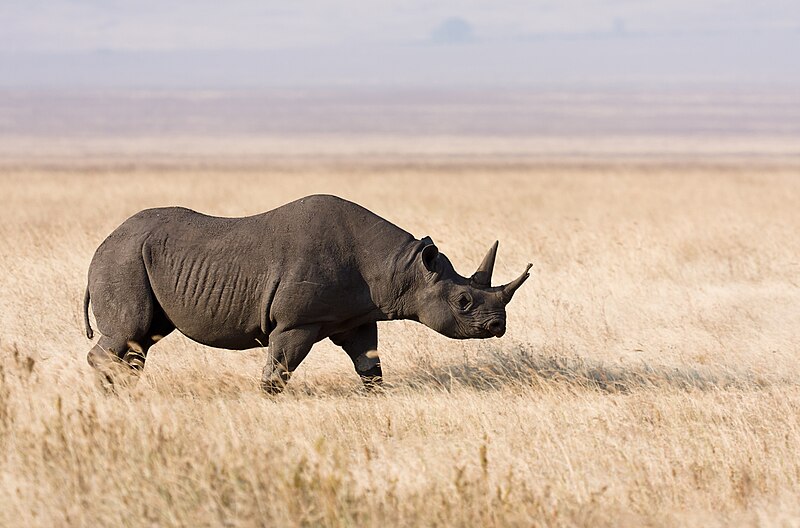
8. Black Rhinoceros
Credit: Ikiwaner
Mass: 800 - 1,400 kg

The black rhinoceros is a species of rhinoceros that is native to the eastern and central areas of Africa. The black rhino is more of a grey/brown colour despite being referred to as black. The species is classified as critically endangered, and the Western black rhinoceros was declared extinct in 2011.  
Males stand at 4.3 - 5.9 ft at the shoulder and are surprisingly fast for their size, capable of reaching speeds of up to 35 mph.

9. Wild Asian Water Buffalo
Mass: 700 - 1200kg

The wild Asian water buffalo is the second-largest species of wild bovid (behind the gaur) and deemed as an endangered animal with maybe only as few as 3,400 left in the world. They have a shoulder height of 150-190 cm (4.9-6.2 ft). They enjoy to live in wet grasslands, swamps and densely vegetated river valleys. Herd sizes may vary, one may be 30 while another may be 500. The maximum recorded life span of a Asian water buffalo in the wild is 25 years.

10. Saltwater Crocodile
 Credit: MartinRe
Mass: 409 - 1000 kg

The saltwater crocodile is the largest of all reptiles, living in Northern Australia, Southeast Asia to the eastern coast of India. When they are newly hatched, saltwater crocodiles are 25-30 cm in length, when they reach adulthood, an adult male can be 13-20 ft. The saltwater crocodile can swim 15-18 mph but most of the time will only move at around 2-3 mph.
They will eat any animal within its range, using its huge jaw muscles to latch onto prey, then dragging them into the water where they will violently spin - drowning the prey whilst ripping bite-able chunks off of it. In 2011 a large saltwater crocodile killed a Bengal tiger when the tiger was crossing a river – the only known attack of this kind. 

I don't claim ownership or credit for the pictures present, all credit is reserved for the original owners. No copyright intended, if you have an issue with a picture that is present, then please contact me. I am in no way profiting from the pictures that are present.

Selasa, 12 Juni 2012

10 Moral-Teaching Aesop's Fables

Aesop was a storyteller known for his numerous fables, which were designed to illustrate a particular lesson or moral-teaching. 
Thought to have been born around the 5th century BC, it's still uncertain whether Aesop existed or not. No writings by him survive, but stories have been credited to him through the centuries. Having said that, the fables that Aesop (whether he was real or fictional) have been named Aesop's Fables. Here is a collection of ten that I chose earlier today and put them together to make this post. Hope you enjoy. :)

1. The Ant and the Chrysalis
An Ant nimbly running about in the sunshine in search of food came across a Chrysalis that was very near its time of change. The Chrysalis moved its tail, and so attracted the attention of the Ant, who then saw for the first time that it was alive. "Poor, pitiable animal!" cried the Ant disapprovingly. "What a sad fate is yours! While I can run here and there, at my will, and, if I wish, climb the tallest tree, you lie imprisoned here in your shell, with power only to move a joint or two of your scaly tail." The Chrysalis heard all this, but did not try to make any reply.

A few days after, when the Ant passed that way again, nothing but the shell remained. Wondering what had become of its contents, he felt himself suddenly shaded and fanned by the gorgeous wings of a beautiful Butterfly. "Behold in me," said the Butterfly, "your much-pitied friend! Boast now of your powers to run and climb as long as you can get me to listen." So saying, the Butterfly rose in the air, and, flew along and aloft on the summer breeze, was soon was lost to the sight of the Ant forever.
 
Moral: Appearances are deceptive.
2. The Ass and His Masters
An Ass belonging to an herb-seller who gave him too little food and too much work made a petition to Jupiter to be released from his present service and be provided with another master. Jupiter, after warning him that he would regret his request, caused him to be sold to a tile-maker. Shortly afterwards, finding that he had heavier loads to carry and harder work in the brick-field, he petitioned for another change of master. Jupiter, telling him that it would be the last time that he could grant his request, ordained that he be sold to a tanner. The Ass found that he had fallen into worse hands, and noting his master's occupation, said, groaning: "It would have been better for me to have been either starved by the one, or to have been overworked by the other of my former masters, than to have been bought by my present owner, who will even after I am dead tan my hide, and make me useful to him."
 
Moral: He that finds discontent in one place is not likely to find 
happiness in another.

3. The Bear and the Two Travellers
 Credit: Milo Winter 
Two Men were travelling together, when a Bear suddenly met them on their path. One of them climbed up quickly into a tree and hid himself in the branches. The other, seeing that he would be attacked, fell flat on the ground, and when the Bear came up and felt him with his snout, and smelt him all over, he held his breath, and pretended to be dead as much as he could. The Bear soon left him, for it is said he will not touch a dead body. When he was gone, the other Traveller descended from the tree, and jocularly enquired of his friend what it was the Bear had whispered in his ear. "He gave me this advice," his companion replied. "Never travel with a friend who deserts you at the approach of danger."
 
Moral: Misfortune tests the sincerity of friends.

4. The Crab and its Mother
A Crab said to her son, "Why do you walk so one-sided, my child? It is far more becoming to go straight forward." The young Crab replied: "Quite true, dear Mother; and if you will show me the straight way, I will promise to walk in it." The Mother tried in vain, and submitted without protest to the reproof of her child.
 
Moral: Example is more powerful than precept.

5. The Dove and the Ant
An Ant, going to a river to drink, fell in, and was carried along in the stream. A Dove pitied her condition, and threw into the river a small twig, by means of which the Ant gained the shore. The Ant afterwards, seeing a man with a gun aiming at the Dove, stung him in the foot sharply, and made him miss his aim, and so saved the Dove's life.
 
Moral: Little friends may prove great friends.

6. The Fox and the Eagle
An Eagle and a Fox formed an intimate friendship and decided to live near each other. The Eagle built her nest in the branches of a tall tree, while the Fox crept into the undergrowth and there produced her young. Not long after they had agreed to this plan, the Eagle, being in want of provision for her young ones, swooped down while the Fox was out, seized upon one of the little cubs, and feasted herself and her brood. The Fox on her return, discovered what had happened, but was less grieved for the death of her young than for her inability to avenge them. 

A just retribution, however, quickly fell upon the Eagle. While hovering near an altar, on which some villagers were sacrificing a goat, she suddenly seized a piece of the flesh, and carried it, along with a burning cinder, to her nest. A strong breeze soon fanned the spark into a flame, and the eaglets, as yet unfledged and helpless, were roasted in their nest and dropped down dead at the bottom of the tree. There, in the sight of the Eagle, the Fox gobbled them up.
 
Moral: Do unto others as you would have them do unto you. 

7. The Frogs and the Well
 
Two Frogs lived together in a marsh. But one hot summer the marsh dried up, and they left it to look for another place to live in: for frogs like damp places if they can get them. By and by they came to a deep well, and one of them looked down into it, and said to the other, "This looks a nice cool place. Let us jump in and settle here." But the other, who had a wiser head on his shoulders, replied, "Not so fast, my friend. Supposing this well dried up like the marsh, how should we get out again?"
 
Moral: Look before you leap. 

8. The Hare and the Tortoise
A Hare one day ridiculed the short feet and slow pace of the Tortoise, who replied, laughing: "Though you be swift as the wind, I will beat you in a race." The Hare, believing her assertion to be simply impossible, assented to the proposal; and they agreed that the Fox should choose the course and fix the goal. On the day appointed for the race the two started together. The Tortoise never for a moment stopped, but went on with a slow but steady pace straight to the end of the course. The Hare, seeing how far ahead it was than the tortoise, decided to lie down by the wayside and fell fast asleep. At last waking up, and moving as fast as he could, he saw the Tortoise had reached the goal, and was comfortably dozing after her fatigue.
 
Moral: Slow and steady wins the race.

9. The Lion and the Eagle
An Eagle stayed his flight and requested a Lion to make an alliance with him to their mutual advantage. The Lion replied, "I have no objection, but you must excuse me for requiring you to find surety for your good faith, for how can I trust anyone as a friend who is able to fly away from his bargain whenever he pleases?"
 
Moral: Try before you trust.

10. The Lion and the Mouse
A Lion was awakened from sleep by a Mouse running over his face. Rising up angrily, he caught him and was about to kill him, when the Mouse piteously entreated, saying: "If you would only spare my life, I would be sure to repay your kindness." The Lion laughed and let him go. It happened shortly after this that the Lion was caught by some hunters, who bound him by strong ropes to the ground. The Mouse, recognising his roar, came and gnawed the rope with his teeth and set him free, exclaiming: "You ridiculed the idea of my ever being able to help you, expecting to receive from me any repayment of your favour; now you know that it is possible for even a Mouse to con benefits on a Lion."

Moral: Little friends may prove great friends.

I don't claim ownership or credit for the pictures present, all credit is reserved for the original owners. No copyright intended, if you have an issue with a picture that is present, then please contact me.

Selasa, 06 Maret 2012

10 of the Strangest Looking Birds.

In the world, there are some weird and wonderful creatures. Things that make you stop and go 'awwwwwwww', and others that make you go 'what is that'?

This post I've gone for the 'what is that' approach on birds.
I'm sure there are a few other strange birds that you feel should have been on the list, but nevertheless, hope you enjoy.

1. Abyssinian Ground Hornbill
This unusual looking bird is the Abyssinian ground hornbill (sometimes referred to as the Northern ground hornbill,) is one of two species of ground hornbill.
It's found north of the equator and is an African bird.

They can live up to 40 years of age, and a group may have a territory of 2-100 square miles.

They eat small vertebrates and invertebrates including tortoises, lizards, spiders, beetles, and caterpillars; and some seeds and fruits.

2. Helmeted Hornbill
The helmeted hornbill is a large bird of the hornbill family being found in the Malay peninsula, Sumatra and Borneo.

The body length is 95–120 cm (38–47 in). Males weigh 3.1 kg and females weigh about 2.7 kg. Unlike other hornbills, the helmeted hornbill's casque is solid, and the skull including the casque and bill, may make-up 10 percent of the bird's total weight.

The call is described as hoots followed by maniacal laughter. Males fight using their casques.

3. Quetzal
The quetzal is a member of the trojan family, being found in forests, woodland and humid highlands.

They grow to over 30cm in length and are marginally larger than their relatives in the trojan family tree.
They feed on fruits, berries, insects and small vertebrates.

4. Hoatzin
The hoatzin is a species of tropical bird found in riverine forest and mangrove of the Amazon and the Orinoco delta in South America.

They are renowned for having chicks that possess claws on two of their wing digits. They grow up to 65cm in length and have a distinguishable marooned-eyed blue face.

This is a noisy species, which usually incorporate some sort of body movement (like the spreading of the wings) with their calls.

5. Hoopoe
The hoopoe is found across Afro-Eurasia and is recognised for its unique head 'spikes'. The hoopoe is classified in the same group as kingfishers, woodhoopoes, rollers, and bee-eaters.

The hoopoe is widespread in Europe, Asia, and North Africa, Sub-Saharan Africa and Madagascar, and make seasonal movements in response to rain. The hoopoe can grow anywhere from 25-32cm.

Having a muscular head, the hoopoe is able to open its beak when it is inside the ground.

There diet consists of mostly insects, but they can also eat seeds and berries, and small lizards and frogs.

6. Sri Lanka Frogmouth
The Sri Lanka frogmouth is an unusual species of bird found in the Western Ghats of south India and Sri Lanka. They are nocturnal creatures who spend their lives in forest habitats.

The bird can grow to be 23cm in length.
With their large heads and forward facing eyes, the Sri Lanka frogmouth has good binocular vision.

To avoid being seen they slowly move the head to point up their bill and can easily be mistaken for a jagged broken branch.

7. Shoebill Heron
The shoebill heron is a large bird distinguished for its shoe-shaped bill. After maturity, adults are generally grey in colour and stand at around 114 - 150cm, and their beaks are around a foot in length. Juveniles are brown in colour.

Shoebill's live in the tropical east Africa in large swamps from Sudan to Zambia.

Their diet consists of fish, frogs, reptiles, and small mammals.
They are labelled as a vulnerable species.

8. Cassowary
Cassowaries are large flightless birds which live in the tropical forests of New Guinea. They are the third tallest bird in the world, behind the ostrich and emu.

The main part of a cassowaries diet is made up of fruits, but can also eat fungi, shoots, grass seeds, invertebrates and small vertebrates.

Although the bird is timid, it has a reputation for its vicious kicks that are able to seriously injure, or sometimes kill a person.

The average height of an adult cassowary can be anywhere from 4.9ft to 5.9ft.

Cassowaries can run up to 31 mph through forests and can jump up to 1.5 metres, and they are good swimmers, crossing rivers and swimming in the sea as well.

9. Kiwi
Kiwi's are small flightless birds that are native to New Zealand. There are five known species, which are all endangered.

In relation to their body size kiwi's lay the largest egg of any bird on the planet, and so only lay one every season. The bird has become a national symbol for the country of New Zealand.

Stoats, dogs, ferrets, and cats are the most dangerous threat to kiwi numbers.

10. Marabou Stork 
 Credit to Tony Northrup
The marabou stork is a large wading bird which live in Africa and the south of the Sahara. It is sometimes referred to as the 'undertaker bird' due to its appearance from behind.
Adults are capable of reaching a height of 153cm.

A frequent scavenger, it is not uncommon to see marabou stork's alongside vultures when feeding (who are also great scavengers). 

They mainly eat carrion, but can also eat frogs, fish, insects, eggs, small mammals, reptiles, quelea nestlings, pigeons, doves, pelican and cormorant chicks, and flamingos.


I don't claim ownership or credit for the pictures present, all credit is reserved for the original owners. No copyright intended and I'm not profiting off of them. If you have an issue with a picture that is present, then please contact me.

Senin, 19 Desember 2011

10 Huge Dog Breeds

Some dogs are tiny, whilst others are huge. I've decided to put together a list of 10 huge dog breeds and have included photos. 

This isn't an official 'top 10' list as there are lots of really big dogs, however these are some that are at the top end of the list.

The ordering of the dogs isn't an indication of size.

1. Anatolian Shepard
The Anatolian Shepherd (also known as the Karabash) is a muscular breed of dog with thick necks, broad heads and sturdy bodies.    

Originating in Anotolia (central Turkey), the Anatolian Shepherd is used for guarding flocks of sheep, being able to stand up against wolves, horses, and surprisingly lions.
They have excellent hearing and sight, with outstanding strength.

According to Turkish shepherds, a pack of 3 Anatolian Shepherd is sufficient to fight off a pack of wolves with the ability to injure a couple.

Males stand at 26-31 inches and females at 27-30 inches. They weigh in the region of 90-150 lbs (41-68kg), males being on the larger side and females on the smaller.


2. Great Dane
 Copyright De la VallĂ©e des Eolienne breeding
The Great Dane (also known as the German Mastiff or Danish hound) is one of the tallest breeds of dog, recognized by many for its large size.

Males stand at 30-34 inches, females at 28-32 inches.
The tallest dog on record is held by a blue Great Dane named 'Giant George' who stands at an impressive 43 inches (110cm) at the shoulder!

Males weigh 120 lbs (54kg) upwards, females at 100 lbs (45kg) and upwards.

3. Irish Wolfhound
Credit to SheilaKane
The Irish Wolfhound is a sighthound (which use speed and sight primarily for hunting instead of endurance and scent).

They have very flexible backs and long legs, which they need for capturing fast, agile prey such as deer and hare.

They have very efficient lungs for sprinting and large hearts.
Irish Wolfhounds stand at 28-35 inches, males being the upper half and the females the lower.

They weigh in at around 90-150 lbs (40-68kg), males being the upper side and the females on the lower.

4. English Mastiff
The English mastiff is an extremely powerful breed of dog, with an enormous head and a huge robust body. Noted for its gentle temperament the mastiff has seen an increase in popularity since the 80's.

It is the largest dog breed in mass out of any other dog. A typical male can weigh anywhere from 150-250 lbs(68-110kg), and females at 120-200 lbs (54-91kg). The standard height for males are 30 inches (76cm), and for females 27.5 (70cm) inches for females.

Despite the fact that Great Danes and Irish Wolfhounds can be taller, many consider the English Mastiff to be the largest of all dog breeds because of its sheer body mass, and still very respectable height.

5. St Bernard
The St Bernard is a very big working dog from the Swiss and Italian Alps that is well known for it's popularity for mountain rescue.

It stands anywhere between 25.5-28 inches (61-71cm), and weighs 110-200 lbs (50-91kg).
The most famous St Bernard to have lived was a dog named Barry, with reports indicating that he saved 40-100 lives.

6. Greater Swiss Mountain Dog
The Greater Swiss Mountain dog (also known as Swiss cattle dogs) are originally from the Swiss Alps. There are four breeds of this dog, the Greater Swiss Mountain dog being the largest of the four.

They stand at 23.5-28.5 inches (60-72cm), and weigh around 130-135 lbs (59-61kg).
In the past they have been used as livestock guardian dogs, guard dogs, herding dogs and even dogs that pull small carts. 

7. Neapolitan Mastiff
Credit to Iscribbly
Neapolitan Mastiff's (also known as the Italian Mastiff) is a large breed of dog often used as guarding dogs because of their protective instincts.

They are seen as 'fearless' and rarely let their presence be known to intruders, as they prefer to sneak up on them.
Males stand at 26-31 inches (66-79cm), and females at 24-29 inches (61-75cm). The males weigh in at 130-155 lbs (60-70kg), and females at 110-130 lbs (50-60kg).

They are very intelligent dogs with a streak of independence.
They are very tolerant of pain due to the breed's early fighting background and the fact the skin is loose on the body, so it may be hard to know if anything is wrong with it. Routinely check-ups are recommended.

The record for the largest litter of puppies is held by a Neapolitan Mastiff which gave birth to 24 puppies!

8. Newfoundland 
The Newfoundland is a breed of large dog bred for fishermen as working dogs. They are recognized for their strength, size, even temperament and loyalty.

They excel at water rescue work and so are popular among lifeguards on beaches. In fact I once saw a video of a man vs Newfoundland to see who could rescue a person out in the sea the quickest.... the Newfoundland won. (The man was a strong swimmer as-well).

They stand at 27-29 inches (69-74cm) for males, while females stand at 25-27 inches (63-69cm).
Males weigh 130-150 lbs (60-70kg), females at 100-120 lbs (45-55kg). The largest ever recorded Newfoundland weighed 260 lbs (120kg).

9. Pyrenean Mountain Dog
The Pyrenean Mountain dog (also known as the Great Pyranees) is a large breed of dog used for livestock guarding.
Males grow to weigh at 110-120 lbs (50-54kg) and females at 80-90 lbs (36-41kg). Males stand at 27-32 inches (69-81cm) and females at 25-29 inches (63-74cm). 

10. Tibetan Mastiff
Tibetan Mastiffs are known for their guarding use, used for guarding livestock, properties, villages and the like. Normally in historical guarding, they would be tied to a rope outside a house as to deter intruders. In nomad camps and villages however, they are allowed to run loose at night.

In Mandarin Chinese, the name is (Zang'Ao), which means 'Tibetan Mastiff' or 'Tibetan "big ferocious dog"'.

The normal height for the breed is 25-28 inches (61-72cm), but males can be known to reach 31 inches and above. The typical weight for a Tibetan Mastiff is 140-180 lbs (64-82kg).


I don't claim ownership or credit for the pictures, all credit is reserved for the original owners. No copyright intended, if you have an issue with a picture that is present, then please contact me.